Narrative over Force: Naim Qassem’s Speech of Justification
Naim Qassem’s recent speech shows Hezbollah’s unsuccessful attempt to shape the narrative of power, to preserve the organization’s former prestige and the enduring legacy of Hassan Nasrallah.
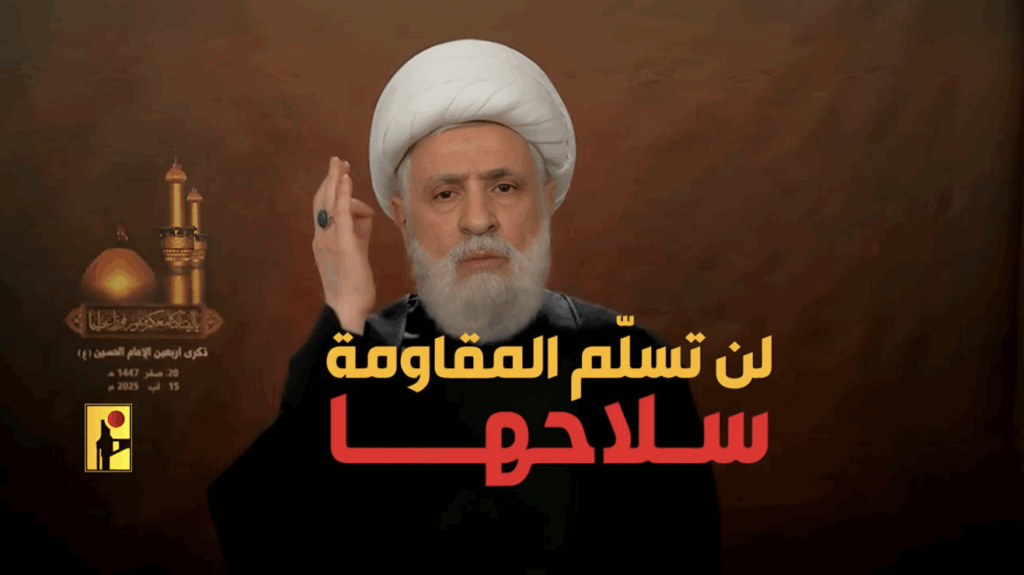
On October 26, Naim Qassem, Hezbollah’s secretary-general, delivered what can be described as a “speech of justification”. In it, he sought to defend his position as leader — or at least to preserve his legitimacy — by highlighting his close ties to former Hezbollah leaders, Hassan Nasrallah and Hashem Safieddine, and by framing the organization’s past decision-making as collective rather than the one-man show it eventually became. He also attempted to evoke the aura that Nasrallah had cultivated around the organization, aiming to anchor his own legitimacy and consolidate his leadership within Hezbollah, among Lebanon’s Shiite community, and in the eyes of its Iranian patron.
However, reality tells a different story. Today, Hezbollah finds itself at its weakest point within the Lebanese arena — even more so than in the aftermath of the 2020 Beirut Port explosion, which was widely attributed to the organization. Its presidential candidate was defeated in the January 2024 elections, calls for disarmament persist, and the group’s legitimacy continues to erode — including within the Shiite community itself. In response, Hezbollah has intensified its cooperation with the Amal Movement, seeking to restore a sense of Shiite cohesion and to advance the broader narrative of “Lebanese unity.” Yet at the same time, the organization continues to undermine state institutions, criticizing the government for its failure to support reconstruction efforts in southern Lebanon and other areas affected by the war with Israel.
Against Israel, Hezbollah is waging a media campaign focused on allegations of ceasefire violations, seeking to present Israel as a regional aggressor driven by the concept of a “Greater Israel” and territorial expansion— a narrative likewise advanced by Iran. This messaging is strongly echoed by Hezbollah’s political ranks; for instance, Hezbollah MP Ibrahim Al Moussawi declared: “Netanyahu has a plan to change Israel’s geography at the expense of neighboring states.”[1]
The purpose of this campaign is to portray Israel as a broad regional threat, thereby preserving the “resistance” narrative that serves as Hezbollah’s core justification for its continued existence—and to delay or prevent any decision to disarm the organization. Furthermore, following the ceasefire with Israel and amid growing perceptions of a stronger Lebanese army, Hezbollah sought to reaffirm its position as the nation’s primary defender. Hezbollah MP Mohammad Raad emphasized this position, stating: “The resistance will continue its national duty until the state demonstrates its ability and willingness to fulfill its responsibility for national defense.”
In practice, Hezbollah has so far refrained from carrying out any major military response against Israel, even as it endures almost daily attacks within Lebanese territory. This restraint may be driven by a desire to project legitimacy and to align with international expectations following the ceasefire. Yet it also likely reflects genuine limitations — internal political pressures within Lebanon and significant operational and military weaknesses.
At lower levels and across unofficial channels on social media, Hezbollah allows itself more freedom of expression. There, they claim that the organization has learned lessons from the recent war with Israel, especially regarding targeted killing of its senior officials. According to these sources, Hezbollah has developed a new, stronger military plan aimed at reinforcing its defensive and deterrent capabilities against Israel and has even decided to respond directly to any future Israeli ground attacks. In reality, the organization has adopted a policy of restraint in the face of extensive Israeli air activity since the ceasefire agreement in 2024, limiting itself to statements about an anticipated escalation in the near future.
A year after the Nasrallah and other senior Hezbollah leaders were eliminated by Israel, the organization remains in a state of profound weakness on all fronts—military, political, and economic. As a result, Hezbollah has been investing heavily in the domain of perception shaping. This is the very tool that Nasrallah himself mastered for years, and now his successors are attempting to use it to reshape the group’s image—toward Israel, the Lebanese public, and the Shiite community.
It is clear that Hezbollah is devoting significant effort to rehabilitation, yet the threat of disarmament and Israeli strikes remains a constant concern. In fact, the central question now—one that remains unanswered—is how the organization will respond if and when the Lebanese state decides to take concrete action to disarm it, and what such a move would mean for the northern front with Israel.
[1] Al-Nour. (2025, October 26).Al-Moussawi: Resistance is the only solution in confronting the enemy, and there is a siege (translated from Arabic) Al-Nour News.
The views expressed are those of the author and do not reflect the official position of the International Institute for Counter-Terrorism.