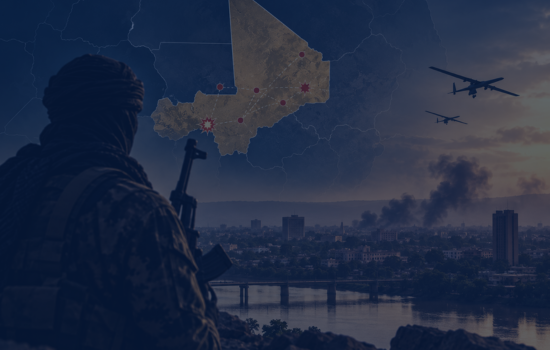
Bamako is No Longer Safe: JNIM Shifts Scale
Mali is entering a new phase in its war against radical jihadist groups. Within just a few days, the Al-Qaeda-affiliated Group for the Support of Islam and Muslims (JNIM) has intensified its attacks against the Malian army and its strategic bases, and is now targeting the outskirts of Bamako. Despite reinforcements to the Malian Armed Forces (FAMa) and support from the Russian “Africa Corps,” Mali’s core security apparatus remains vulnerable.
On the night of September 18–19, a checkpoint in Kasséla, on the outskirts of Bamako, came under attack. Reports indicate that the attackers arrived on foot, armed and equipped with communication devices. They caught the soldiers off guard, killing or wounding several of them before fleeing with weapons and ammunition. Two soldiers initially reported missing were later found safe and sound. JNIM claimed responsibility for the attack, though the details of this claim remain to be verified against information from the ground. [1]
That same day, the threat materialized in Sévaré, a key military stronghold in the center of the country. [2]Suicide drones targeted the airport area and military facilities, including surveillance and attack aircraft. According to the newspaper Le Monde, the airfield at Sévaré had already been targeted on September 14, following the attack on the Konna camp.[3] Reports indicated that the area housing Russian helicopters was targeted by drones, specifically Bayraktar TB2 and Akinci models.[4]
However, the magnitude of the worsening crisis was shown by the September 10 attack on Dioura. [5] According to new data gathered by AFP from military, security, and local sources, over 100 Malian soldiers and five members of the Russian “Africa Corps” were killed.[6] A military source also reported approximately 100 missing, 30 wounded, and 30 taken prisoner. A local official claimed that more than 80 soldiers were captured and that the camp was abandoned following the attack.[7] Nevertheless, the Malian army has not issued an official statement confirming these figures.
JNIM claims to have killed 150 soldiers and captured 93; this figure cannot be independently verified.
However, even the AFP’s more conservative death toll makes the Dioura event one of the worst losses Malian forces have experienced recently. The army’s capacity to maintain its positions and defend its own bases is now directly in jeopardy, thus the problem is no longer just one of insecurity in rural areas.
It appears that JNIM’s strategy is evolving toward a combination of military pressure, logistical strangulation, and harassment of key power centers. Following the attacks around Bamako in the spring, the group had already sought to disrupt the capital’s fuel supply. A previous blockade of major roads caused severe shortages and demonstrated that the jihadists could exert economic pressure on Bamako without needing to capture the capital itself.
The current pattern is different. It directly targets military infrastructure: Dioura, Konna, Sévaré, and Kassala. These objectives present a concerning image: air power is being targeted, the country’s center is under attack, and Bamako’s suburbs are once again under fire.
The modus operandi of *Jama’at Nasr al-Islam wal-Muslimin* (JNIM)—Al-Qaeda’s dominant affiliate in the Sahel—involves a sophisticated blend of asymmetric warfare, economic blockades, and strategic alliances.
While JNIM initially operated primarily through ambushes in rural areas of northern and central Mali, its operational doctrine has expanded into a well-coordinated, nationwide campaign aimed at breaking the grip of the ruling military junta and its Russian ally, the “Africa Corps.” JNIM – Modus Operandi
1. Tactical and military warfare: The organization relies heavily on high mobility and massive firepower to wear down state defensive formations. This mobility is exemplified by mass motorcycle maneuvers; fighters move in large groups on motorcycles—vehicles ideal for rapid attacks, off-road movement, and quick escapes across the Sahelian terrain.
2. Simultaneous multi-front attacks: The organization frequently initiates coordinated attacks spanning hundreds of kilometers. They strike multiple military outposts, checkpoints, and settlements simultaneously to paralyze the military’s ability to deploy reinforcements.
3. Night raids on isolated bases: JNIM deliberately targets remote military bases under conditions of poor visibility to maximize confusion and force the military into a constant, exhausting state of high alert.
4. Use of Vehicle-Borne Improvised Explosive Devices (VBIEDs) and indirect fire: Insurgents disrupt coordinated base defenses by softening targets with mortars, rocket-propelled grenades (RPGs), and destructive VBIEDs used to breach the defensive perimeter.
5. Economic warfare and siege tactics: A significant shift in JNIM’s strategy has manifested in a move from mere territorial conquest to the economic strangulation of the Malian state. They achieve this by blocking supply routes; the organization imposes a severe economic siege on major cities, most notably the capital, Bamako. They enforce this by blocking key trade arteries connecting Mali—a landlocked country—to its coastal neighbors, such as Senegal and Ivory Coast. Additionally, they target infrastructure and energy facilities, while militants systematically carry out ambushes. They set fire to and hijack commercial fuel tankers. This has led to a devastating nationwide fuel shortage, power outages, and flight disruptions, effectively eroding public patience with the junta.[8]
6. Extortion and illicit revenue: They manage people smuggling routes, demand unofficial “protection fees” from the locals, and assault foreign industrial and gold-mining facilities in the absence of ransom payments.
7. Instead of fighting all factions simultaneously, JNIM employs opportunistic political maneuvers to scatter and stretch state forces thin. JNIM has forged an unprecedented military alliance with the Front for the Liberation of Azawad (FLA)—a separatist organization dominated by the Tuareg people.[9] The parties set aside their ideological differences to conduct large-scale joint operations against the Malian military and Russian mercenaries—such as the major offensive that led to the recapture of Kidal, a strategic stronghold in the country’s north.[10]
The Malian army claims that it is continuing its operations. On September 17 and 18, the Malian General Staff announced strikes against positions attributed to armed groups in Djenné, Sévaré, and Ber, as part of “Operation Dougoukoloko”.[11] It was reported that bases, vehicles, motorcycles, and fuel depots were destroyed. These announcements indicate that Mali’s security forces (FAMa) have retained offensive capabilities; however, these alone do not allow for a full assessment of the security apparatus’s overall effectiveness.
Since the departure of French forces and the shift toward Russia, Mali’s junta has made the military reconquest of territory a cornerstone of its strategy. The arrival of “Africa Corps” mercenaries was intended to bolster this capability. Recent attacks reveal a far more complex reality: merely possessing manpower, weapons, and drones is insufficient when the adversary maintains mobility, local intelligence networks, the element of surprise, and control over certain rural areas.
Bamako, the national capital, is bolstering security measures, particularly around major roads and critical infrastructure. Le Monde reports that authorities fear further attacks, as the army has been compelled to concentrate some of its resources in the capital for Independence Day ceremonies.
Through its offensive operations and their outcomes, JNIM demonstrates that the Malian army’s capabilities are inadequate to ensure the country’s security.
The paradox is now difficult to conceal: the more the junta concentrates its security apparatus around centers of power, the more opportunities armed groups have to launch attacks elsewhere before eventually returning to the gates of Bamako.
Who, then, will stop the JNIM terrorists? The majority of the route to Bamako is open.
The question is no longer merely whether the Malian army can retake one camp or another. The question is whether it can sustainably control the roads, defend its bases, secure its supply lines, and prevent armed groups from leveraging widespread insecurity to exert direct pressure on the capital, Bamako. This is the junta’s ultimate challenge in Mali.
David Doukhan Ph.D.
October 4, 2026
[1] Unconfirmed attack on Bamako’s northeastern approach
[2] The military base in Sévaré is a key strategic military facility located in the Mopti region of central Mali, near the Sévaré-Mopti airport. The base is situated at the junction of major roads connecting the north and south of the country. It serves as the Malian army’s primary operational hub in central Mali and has previously hosted foreign or allied forces, including Russian paramilitary personnel (such as the Wagner Group / ‘Africa Corps’).
Jihadists target Sévaré and a checkpoint near Bamako, and ramp up strategic attacks
[3] The Konna army camp is a strategic military facility located in the town of Konna, in the Mopti region of central Mali. It serves as a critical defensive gateway between the government-controlled southern territories and the volatile northern desert regions. Located along the RN16 highway, Konna has long marked the frontline in the struggle for territorial control; its fall to Islamist rebels in January 2013 triggered the French military intervention in the country. Following years of instability, a new, fortified military camp was officially inaugurated in March 2021 by Mali’s transitional government, intended to symbolize enduring resilience against regional terrorism. The base and its surrounding areas have hosted Russian military forces—historically known as the Wagner Group, but now rebranded and operating under the “Africa Corps”—to support the Malian armed forces.
[4] Dans le centre du Mali, les djihadistes du GSIM relancent des offensives d’envergure
[5] La guerre que la junte peine à endiguer
[6] Dioura, the setback that raises questions about Africa Corps’ effectiveness?
[7] Anguish grips Mali families after military camp massacre
https://www.afp.com/en/anguish-grips-mali-families-after-military-camp-massacre
[8] Terrorist roadblocks strangle the economies of Mali and its neighbors
[9] The talks in early 2025 were made possible, among other factors, by the efforts of Al-Ghabass Ag Intalla—an influential figure in the FLA—and Iyad Ag Ghali, the Tuareg leader of the JNIM organization.
JNIM’s External Communications in 2025
https://theafricainsight.substack.com/p/jnims-external-communications-in
[10] JNIM, FLA Alliance Intensifies Conflict in Mali
[11] Operation Dougoukoloko is an ongoing military operation by the Malian Armed Forces (FAMa) aimed at combating terrorist groups and jihadist militias across the country. Its objectives include clearing terrorist strongholds, destroying insurgent logistical infrastructure, securing transport routes, and protecting the civilian population. The operation is being conducted across several sectors and regions of Mali (including central areas, eastern regions such as Gao, and northern areas such as Timbuktu). The forces are combining ground operations, engineering reconnaissance, and extensive airstrikes with support from various entities. Alongside combat operations, the army reports civil-military activities, including food delivery, securing local markets, and escorting supply convoys essential for the population.
Operation Dougoukoloko: Malian Army Targets Terrorist Groups’ Logistics