“I Accuse!”: Walid al-Qatati, a Palestinian Islamic Jihad Representative, Launches a Sharp Critique of Hamas
Relations between Hamas and Palestinian Islamic Jihad (PIJ) are characterized by a complex dynamic of operational cooperation alongside latent competition. Although the two organizations share an ideological commitment to armed struggle against Israel, they differ in their modes of operation. Over the years, Hamas has maneuvered between the constraints of governing and its civic responsibilities in the Gaza Strip, on the one hand, and its militant vision, on the other. Palestinian Islamic Jihad, by contrast, has maintained the structure of a militant organization that does not bear the burden of governance and operates in alignment with Iran.
Despite the united fighting front presented by the two organizations following the October 7 attack, the devastating consequences of the war have once again brought their differences to the surface. An unprecedented expression of these tensions appeared in January 2026 in a substantial volume published by Walid al-Qatati, a member of the political bureau of Palestinian Islamic Jihad. In his book, al-Qatati launched a sharp critique of the Hamas leadership, accusing it of initiating a unilateral, adventurist, and irresponsible course of action on October 7 and of making the decision without prior strategic coordination, thereby bringing extensive destruction upon the Gaza Strip.[1]
This article examines in depth the indictment and exceptional criticism directed by al-Qatati at Hamas, analyzes the responses and reverberations that the publication generated within the Palestinian arena, considers the significance of this development, and assesses whether it affected relations between the two organizations.
Profile of Walid al-Qatati
Walid al-Qatati, a resident of Rafah in the southern Gaza Strip, is a member of the general political bureau of Palestinian Islamic Jihad and is responsible for the Gaza arena. He is regarded as belonging to the first generation of the organization’s founders and heads a political research institute affiliated with the movement. Al-Qatati is considered one of the movement’s prominent intellectuals and has authored numerous books and studies. He received his higher education at Cairo University (2012), where he earned a PhD in education, specializing in psychological counseling. He has published, and continues to publish, numerous articles on the Palestinian issue, including through the Lebanese al-Mayadeen channel, which is associated with Hezbollah, while promoting the legacy and vision of Fathi Shaqaqi, the organization’s founder.[2]
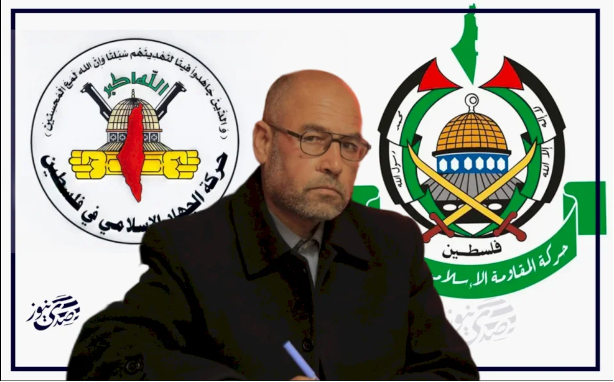
Walid al-Qatati, member of the political bureau of Palestinian Islamic Jihad.[3]
Hamas in the Crosshairs: Walid al-Qatati’s Criticism
In January 2026, Walid Ali al-Qatati published a substantial volume of more than 400 pages entitled “Palestinian Tragedy: Inspired by the War (Part 5)”. This is the fifth installment in a four-part series bearing the same title, in which al-Qatati addresses Palestinian affairs and the thought of Fathi Shaqaqi.
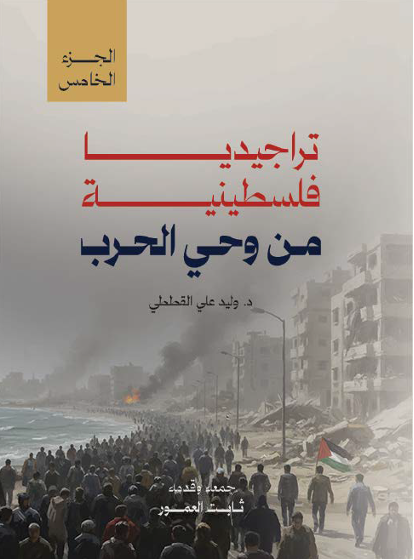
Cover of Walid al-Qatati’s book, Palestinian Tragedy: Inspired by the War (Part 5)
The fifth volume contains not only observations and documentation of the war in Gaza between 2023 and 2025, but also a critical analysis of the events, an examination of the resistance strategy, and a reckoning with the price it has exacted from the Palestinian people. In particular, the book constitutes an indictment and a harsh critique of Hamas, accusing it of reckless adventurism, arrogance, a lack of strategic planning, abandonment of the civilian population, bringing a new Nakba upon the Palestinians, and unleashing the “Israeli monster.” Several major themes can be identified in the book:
1. Unilateral and Irresponsible Decision-Making
Al-Qatati describes how, already on the morning of October 7, as he heard the sounds of the bombardment, he realized that Hamas had embarked on an “ill-considered adventure”. He emphasized that the decision to go to war was made by a small and secretive military group within Hamas, without internal strategic discussion or the involvement of the political leadership and other factions. In his view, this constituted a grave strategic failure.[4] He wrote: “Did they expect the Israeli response to consist only of airstrikes, or a limited war that would end in a prisoner-exchange deal in which they would achieve another victory, in addition to the victory of the first day of the war?”.[5] In his assessment, the decision to launch the attack amounted to “strategic stupidity,” because the Hamas leadership failed to take into account the balance of power and the expected Israeli and Western response. [6]
2. Operation “Al-Aqsa Flood” as a Strategic Failure
Al-Qatati acknowledges that a striking tactical military success was achieved on the first day, but argues that this success quickly dissipated and was eclipsed by the “strategic failure” and the extensive destruction inflicted on the Palestinian people. According to him, Hamas leaders neither anticipated nor planned for the scale of the Israeli response or for Israel’s determination to dismantle the Gaza Strip, and their claims of achievement should therefore be regarded as empty rhetoric.[7] Al-Qatati recounts that during the fourth month of the fighting, around February 2024, he met a senior Hamas figure in his tent who admitted that Hamas’s military wing had been intoxicated by a sense of power: “In the movement’s special meetings, we used to believe that we had an atomic bomb, and that the ultimate victory was near […] and would come within no more than a few years, perhaps even a few months. But the leaders of the Qassam Brigades and Hamas underestimated the enemy’s capabilities while exaggerating those of the Qassam Brigades…”.[8] Another Hamas member whom al-Qatati met was convinced that Hamas would receive a miracle that would lead to the defeat of the Jews.[9]
3. Abandonment and Sacrifice of the Palestinian People for the Sake of the Operation
Al-Qatati seeks to illustrate the severity of Hamas’s disregard for the lives of Palestinian civilians through a metaphor. He cites an old Egyptian joke about a doctor who leaves the delivery room and tells the husband: “We sacrificed the mother and the fetus so that the operation would succeed.” According to al-Qatati, Hamas acted in precisely this manner during Operation Al-Aqsa Flood. Hamas sacrificed the people (the mother) and their future (the “fetus”) for the sake of the military operation’s success. He therefore sharply criticized Ismail Haniyeh for his repeated speeches praising the operation while completely ignoring the tangible devastation in Gaza and the suffering of ordinary people.[10]
4. Hamas’s Conceptual Failure Regarding the Meaning of Victory
Al-Qatati challenges Hamas’s interpretation of “victory” as the survival of its leadership. In his view, this conception is fundamentally flawed, characterized by arrogance and self-deception, and indicative of a disconnect from the population and a complete disregard for Palestinian suffering and the destruction of the Strip. He therefore criticized statements by Osama Hamdan, a senior Hamas official, concerning the day after victory over Israel, arguing that they failed to address the plight of the Palestinians. According to al-Qatati, Hamdan reflects a conception characteristic of the Hamas leadership, which sanctifies remaining in power and prioritizes it over the interests of the people and the homeland.[11]
Al-Qatati also argues that the Qatari channel al-Jazeera shares responsibility for cultivating this flawed conception of victory because it promoted Hamas’s victory narrative. As an example, he notes the extensive praise al-Jazeera devoted to the appointment of Yahya Sinwar as head of Hamas’s political bureau following the assassination of Ismail Haniyeh in Tehran. The purpose, in his view, was to demonstrate that the Hamas leadership continued to function and survive. For al-Qatati, this approach reflects a distorted logic and ignores the tragedies suffered by the Palestinian people as a result of the devastating war.[12]
Al-Qatati further argues that the Muslim Brotherhood movement, to which Hamas belongs, also promotes a mistaken and distorted conception of victory. As an example, he cites a large demonstration organized by Muslim Brotherhood activists in Jordan under the slogan “Gaza Has Won”, based on the distorted logic that as long as Israel fails to eliminate the Hamas leadership, this constitutes a victory for Gaza.[13]
5. Hamas’s Failed Leadership
Al-Qatati emphasizes that one of the characteristics of prudent and wise leadership is the ability to anticipate the future and to make decisions and formulate policy accordingly. When leadership lacks such an ability, however, it may lead its people toward destruction and devastation and hinder their efforts at liberation. In his view, the Hamas leadership lacked this capacity and failed to read the situation correctly; consequently, its decision to launch Operation “al-Aqsa Flood” was misguided.[14] Al-Qatati calls on the Hamas leadership to act responsibly and acknowledge the failure of Operation “al-Aqsa Flood” in order to learn from its mistakes. Regrettably, he argues, while the Israeli enemy has shown a willingness to acknowledge failures and investigate them – as former IDF Chief of Staff Herzi Halevi did when he ultimately resigned – Hamas has entrenched itself in an outright refusal to acknowledge failure or accept responsibility for the consequences of its actions. In his view, these represent two different patterns of thought and approaches: the first, represented by Israel, leads to victory, whereas the second, represented by Hamas, leads to defeat.[15]
6. Palestinian Islamic Jihad as a Prudent and Responsible Leadership, in Contrast to Hamas
Against the backdrop of his harsh criticism of Hamas, al-Qatati presents Palestinian Islamic Jihad as a responsible leadership that is sensitive to the needs of Gaza’s civilian population, in contrast to Hamas. According to him, Hamas failed to understand the doctrine of Fathi al-Shaqaqi and Ramadan Shallah, the founders and leaders of Palestinian Islamic Jihad, which advocated managing the conflict prudently without endangering the welfare of the Palestinians. In other words, al-Qatati portrays the doctrine of the founders of Palestinian Islamic Jihad as an ideal intellectual model combining measured and calculated resistance with consideration for the population’s capacity to endure and for the preservation of Palestinian lives.[16]
From his perspective, genuine jihad is committed to preserving the existence and security of the Palestinian people, whereas the irresponsible adventure initiated by Hamas led to the destruction of infrastructure, existential devastation, and the danger of displacement and annihilation.[17]
Comparison of PIJ and Hamas According to al-Qatati
| Criterion | Hamas | PIJ |
| Sensitivity to the Civilian Population | Abandonment of the civilian population to destruction, repeated displacement, hunger, and deprivation without an adequate civilian response. | Protection of people’s lives, preservation of their dignity, and ensuring their survival on their land as a fundamental principle. |
| Definition of Victory | Reducing victory to the physical survival of the leader or organization in the tunnels. | Victory is measured by strengthening the status, resilience, and achievements of the Palestinian people. |
| Leadership Responsibility | Avoidance of responsibility and disregard for the heavy human cost. | A commitment to self-examination, willingness to assume responsibility, and acknowledgment of strategic mistakes. |
Responses to al-Qatati’s Criticism
Al-Qatati’s book and his sharp criticism of Hamas did not receive an official response from Hamas-affiliated media outlets. This deliberate silence may have been intended to preserve unity between Hamas and its ally, Palestinian Islamic Jihad, and to prevent fissures within the resistance camp. It is also possible that Hamas did not wish to amplify the publication, since any response to the book might have damaged Hamas’s legitimacy at the Palestinian, regional, and even international levels.
Nevertheless, al-Qatati’s book generated responses on social media from Palestinians living in Gaza and elsewhere. The discussion was characterized by mixed feelings and ambivalence. On the one hand, Palestinian users welcomed al-Qatati’s courage and honesty in bringing the truth into the open. On the other hand, Gazan users accused al-Qatati and Palestinian Islamic Jihad of sharing responsibility for the catastrophe that Hamas brought upon Gaza’s residents.[18]
For example, a Gazan Facebook user praised al-Qatati and recommended reading his book: “To be clear, on a personal level, Dr. Walid is a respectable and educated man, with a national record that protects him from any attempt to question his integrity or standing. To this day, he serves as a member of the political bureau of the Palestinian Islamic Jihad movement. This is precisely what makes the book important”. At the same time, however, the user expressed regret that al-Qatati’s criticism had come too late, after the damage had already been done. The user emphasized that al-Qatati’s criticism “does not absolve him of the responsibility borne by the movement, since it was a partner in Hamas’s gamble, which brought disaster upon an entire people. This was while the Islamic Jihad movement remained completely silent, did not utter even a single word of condemnation of this gamble, and did not exert real pressure on Hamas to accept a ceasefire before Gaza was destroyed. Like Hamas, the Islamic Jihad movement did not place the welfare and survival of the people at the top of its priorities, but rather its collection of worn-out slogans. Indeed, at times it adopted positions even more radical than those of Hamas. Therefore, it too bears responsibility, together with Hamas, for what happened to the Palestinian people in Gaza and for the damage caused to the Palestinian cause – whether because of its positions during the war or its positions before the war.”[19]
The Gazan user stressed that although al-Qatati also bears responsibility, “it is good that he revealed the truth, even if it happened after it was already too late. More importantly, he had the courage to declare it, even though those who disagree with you have the right to describe your latest position as an attempt to jump from a sinking ship. Nevertheless, […] I do not absolve you, nor anyone else, of responsibility for this entire delay in declaring an outcome that was inevitable as a result of an ill-considered policy”.[20]
Other Palestinian users from Gaza and elsewhere noted that responsibility for the disaster that befell Gaza rests not only with Hamas and Palestinian Islamic Jihad, but also with other Palestinian organizations, including Fatah and the Popular Front for the Liberation of Palestine. One user remarked that although al-Qatati was engaging in an act of repentance, he should not be absolved of blame, since during the leadership of Ziyad al-Nakhalah, the leader of Palestinian Islamic Jihad, the movement had become “Hamas’s shadow”. Most users called on Palestinian society to learn from al-Qatati’s book, reconsider critically the ideas that had led to the current situation, draw lessons, and stop assigning responsibility to others.[21]
Discussion and Conclusion
An analysis of al-Qatati’s work reveals that beneath the façade of a “united fighting front,” a deep conceptual and strategic rift exists between the two organizations. Al-Qatati levels unprecedented accusations against Hamas: unilateral decision-making, arrogance, failure to assess the strength of the Israeli response, and abandonment of the civilian population in the Gaza Strip. In contrast to what he describes as Hamas’s “irresponsible adventurism” and its conceptual failure in defining “victory”, al-Qatati seeks to position Palestinian Islamic Jihad as a responsible and prudent actor that safeguards the Palestinian national interest.
At the same time, the responses in the Palestinian and Gazan arenas to al-Qatati’s book paint an ambivalent picture. Alongside appreciation for the civic courage and honesty involved in publicly voicing such criticism, some reject PIJ’s attempt to distance itself from responsibility and view it as a full, rather than passive, partner in the disaster that befell the Strip.
The significance of the work lies not merely in its accusations against Hamas. It also constitutes a wake-up call for the resistance factions to undertake a profound process of self-examination. Al-Qatati identifies an existential danger to the ideology of resistance. In his view, the Palestinian public in the Gaza Strip has begun to associate the term “resistance” with suffering, destruction, and abandonment. To prevent the loss of legitimacy of the Islamist militant idea, al-Qatati seeks to conceptually distinguish between the idea of armed struggle itself and Hamas’s arrogant and failed model of governance.
Ultimately, al-Qatati’s work and the reactions it generated are not merely evidence of a searching process of self-criticism; they also open a window onto deep and increasingly visible cracks in the Palestinian “resistance” narrative. This development illustrates how the devastating consequences of the war are eroding the legitimacy of Hamas rule and its operational unity with the other factions, while raising doubts about these organizations’ ability to continue presenting a united front on the “day after.”
[1] Eric Skare, “Texts or Praxes: How Do We Best Understand Hamas and Palestinian Islamic Jihad After October 7?”, CTCSENTINEL, October / November 2023, Vol. 16, Issue 10, pp.34-39. https://ctc.westpoint.edu/texts-or-praxes-how-do-we-best-understand-hamas-and-palestinian-islamic-jihad-after-october-7/; An expression of suspicion and rivalry between the two was evident in May 2024, following the IDF’s disclosure of Hamas intelligence documents indicating that Hamas had planted a spy within the ranks of PIJ. “The Factor That Could Lead to a Breakup Between Hamas and Islamic Jihad Revealed,” (Hebrew) Maariv, May 16, 2024. https://www.maariv.co.il/news/military/article-1099567
[2] Walid al-Qatati, al-Mayadeen. https://www.almayadeen.net/authors/1414581/; Riyadh Abu al-Ras, “Palestinian Tragedy: A Reading of the Thought of Dr. Walid al-Qatati” (Arabic), Shams News, January 22, 2023. https://shms.ps/post/166080/تراجيديا-فلسطين-قراءة-في-عقل-الكاتب-د-وليد-الق-ططي
[3] https://www.sadanews.ps/cached_uploads/resize/960/831/2026/01/05/e3051fbdaaee90d717499cd639f63766-1767638641.jpg.webp
[4] Walid Ali al-Qatati, Palestinian Tragedy: Inspired by the War, 2023–2025 (Part 5) (Arabic), ed. Thabet al-Amour, Gaza: al-Sham Center for Studies and Research, 2025, pp. 35–36.
[5] al-Qatati, Palestinian Tragedy, p.45.
[6] al-Qatati, Palestinian Tragedy, p.64.
[7] al-Qatati, Palestinian Tragedy, p.45, p,128, p,356.
[8] al-Qatati, Palestinian Tragedy, p.66.
[9] Ibid.
[10] al-Qatati, Palestinian Tragedy, p.67.
[11] al-Qatati, Palestinian Tragedy, p.66, p.234, p,352, p.383.
[12] al-Qatati, Palestinian Tragedy, p.234.
[13] al-Qatati, Palestinian Tragedy, p.352.
[14] al-Qatati, Palestinian Tragedy, p.245.
[15] al-Qatati, Palestinian Tragedy, p.357-358, p.383, p.425.
[16] al-Qatati, Palestinian Tragedy, pp.372-375.
[17] al-Qatati, Palestinian Tragedy, pp.120-121.
[18] @ jamil.abedelnabi, Facebook (Arabic), January 18, 2026. https://www.facebook.com/jamil.abedelnabi/posts/pfbid02NaPNbvb5kjYdgkDK4RzR8HTnibv1M2t1MUQtqMnLHbcMjM4brYMNajTmHP7Z77cfl
[19] Ibid.
[20] Ibid.
[21] Ibid.