Rising Tensions on the Lebanon–Syria Border as Hezbollah Alleges Syrian Offensive Preparations
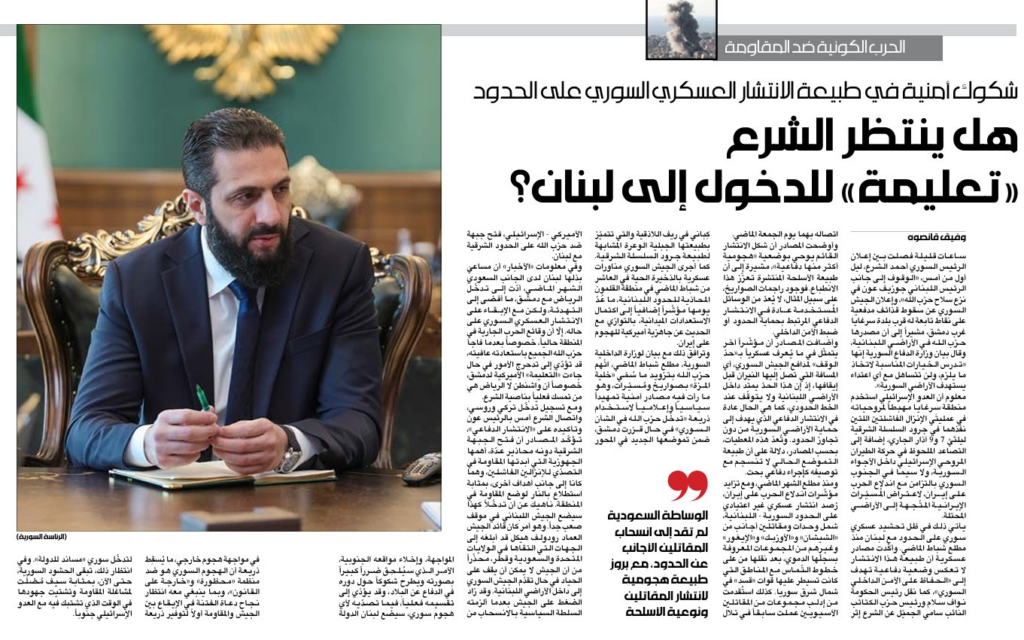
Are the forces of Abu Mohammad al-Julani, the leader of Syria, planning to invade Lebanese territory to exact revenge on Hezbollah? This potential move is viewed either as retaliation for Hezbollah’s involvement in the Syrian Civil War or as part of a strategic deal orchestrated with the Trump administration. Hezbollah has expressed grave concern over the opening of a new front, citing a massive concentration of Syrian forces along the border.
The Lebanese daily Al-Akhbar, which is affiliated with Hezbollah, claims that the Syrian deployment does not resemble a standard defensive posture but rather an aggressive alignment targeting the group. Since early February, an unusual military buildup has been observed, including Syrian units and foreign fighters of Chechen, Uzbek, and Uyghur origin relocated from northeastern Syria. Additionally, groups of Asian militants previously stationed on the frontlines against Kurdish forces have been brought in from Idlib. The nature of the weaponry deployed—including rocket launchers and artillery ranges that extend deep into Lebanese territory—bolsters the assessment that this is an offensive deployment rather than mere border protection.
In parallel, the Syrian army conducted live-fire maneuvers in the Qalamoun region near the Lebanese border in February. This was seen as the final stage of operational readiness, amid rumors of a possible U.S. strike against Iran.
Last month, Lebanon appealed to Saudi Arabia to intervene with Damascus. While Riyadh’s mediation led to a temporary de-escalation, there has been no change in the Syrian troop deployment. Recent regional developments, particularly Hezbollah’s recovery and its ongoing conflict with Israel in southern Lebanon, suggest that the situation could deteriorate if Damascus receives an American “order” to act. According to Al-Akhbar, it is Washington—not Riyadh—that ultimately holds the keys to the Syrian leadership’s decision-making.
A Syrian military intervention would place the Lebanese Armed Forces (LAF) in a precarious position. In meetings in the U.S., Saudi Arabia, and Qatar, the LAF Commander clarified that the army could not remain neutral if Syrian forces entered Lebanese soil. Conversely, if Hezbollah were to vacate its positions in the south to confront a Syrian threat, it would damage its image as the “defender of Lebanon” and potentially trigger internal strife.
In early February, the Syrian Interior Ministry accused Hezbollah of supplying missiles and drones to an armed cell in Damascus—a move seen by some as a pretext to justify Syrian intervention under the guise of “stopping Hezbollah’s meddling in Syrian affairs.”
Notably, Syrian President Ahmad al-Sharaa supports Lebanese President Joseph Aoun’s demand for the disarmament of Hezbollah. Consequently, Hezbollah views the border buildup as a credible offensive threat and is attempting to mobilize the Lebanese government to prevent such a scenario.