A Missed Strategic Opportunity? Al-Qaeda and the Civil War in Sudan
Introduction
Sudan has been plagued for over three years by a bloody civil war between two generals, Burhan and Hemedti, which has been intensified by foreign intervention. The lack of governance, the deterioration of personal security, and the diminishing trust of the local population in the authorities provide favorable conditions for the establishment of Islamic terrorist organizations in the Sudanese space. Abu Hudhayfah al-Sudani, an ideologue of Sudanese origin affiliated with al-Qaeda and a veteran of Osama bin Laden’s battlefields, identifies this war as a historic window of opportunity – alongside a sense of regret over a missed strategic opportunity in the past – and currently calls on al-Qaeda supporters to establish strongholds and jihad bases in the country. Just this July, he published two treatises praising the jihadist war against the Sudanese authorities and demanding the establishment of an Islamic regime based on Sharia law upon their ruins. The Saudi columnist al-Dhaidi noted as early as May 2023 that the question is not whether al-Qaeda will succeed in establishing military strongholds in Sudan, but rather when. [1]
This document seeks to analyze how al-Qaeda attempts to leverage the Sudanese chaos, while examining al-Sudani’s key writings and epistles published in recent years (2022-2026). An examination of his operational plans-which include utilizing rural and mountainous areas to set up rear bases, establishing urban guerrilla cells, and targeted strikes against the regime’s economic infrastructure and financing channels-raises concerns regarding the potential for renewed organizational consolidation. Furthermore, the discussion examines how the proliferation of advanced weaponry, drones, and unmanned aerial vehicles (UAVs) into the current fighting arena could dramatically upgrade the capabilities of terrorist elements, transforming Sudan from a localized crisis center into a hub for exporting regional and international terrorism.
The Civil War in Sudan
The civil war in Sudan, which broke out in April 2023 between the Sudanese Armed Forces (SAF) led by Burhan and the Rapid Support Forces (RSF) led by Hemedti, continues to escalate and worsen in light of the growing use of UAVs, rising civilian casualties, famine, and displacement, while international diplomatic efforts to broker a ceasefire fail.[2] As of September 2026, the number of Sudanese refugees is estimated at approximately 11 million people, with Chad, South Sudan, and Egypt considered the host countries with the highest number of Sudanese refugees – over one million each.[3]
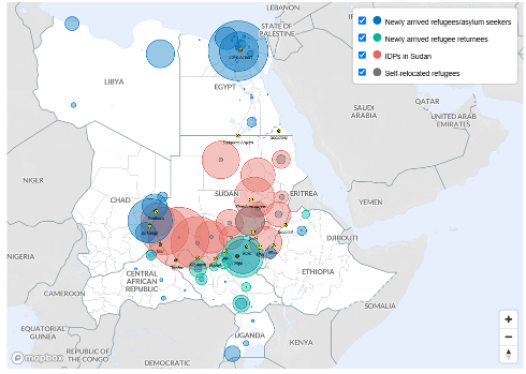
Concentrations of Sudanese Refugees According to UNHCR Data
The civil war in Sudan is also characterized by a distinct regional dimension. A new report by the “UN Independent International Fact-Finding Mission for Sudan” from September 2026 reveals transnational support networks, foreign fighter recruitment systems, and massive quantities of weapons funnelled into Sudan. For example, the Rapid Support Forces (RSF) receive assistance from a transnational network passing through the UAE, Chad, southeastern Libya, and Somalia, through which foreign fighters – spearheaded by some 2,000 military contractors from Colombia – are streamed, alongside advanced weapon systems, attack drones, and artillery. The Sudanese Armed Forces (SAF) also receive substantial foreign support.[4] For instance, General al-Burhan is deepening cooperation with Eritrea due to rising tensions with Ethiopia over border disputes and the Grand Ethiopian Renaissance Dam (GERD),[5] with Iran (which supplies him with drones out of an interest in establishing a foothold in the Red Sea),[6] and with other countries.
The acute and worsening crisis in Sudan has not gone unnoticed by terrorist actors. Sheikh Abu Hudhayfa al-Sudani published several writings starting in 2022 calling to exploit the security instability in Sudan to establish al-Qaeda footholds.
Profile of Sheikh Abu Hudhayfa al-Sudani
Sheikh Abu Hudhayfa al-Sudani, affiliated with al-Qaeda, is a veteran al-Qaeda ideologue of Sudanese origin who fought alongside Osama bin Laden. His life path can be traced through his various writings. He reveals that in 2001, following the US invasion of Afghanistan, he received a direct order from Sheikh Osama bin Laden to carry out a terrorist attack against a US military base in Saudi Arabia near the city of Al-Kharj, south of Riyadh, in revenge for the US invasion of Afghanistan under Taliban rule. Al-Sudani recounts that he arrived at the American base and fired SAM-7 missiles at an American spy plane, but missed. Upon the exposure of this plot by the Saudi security forces, al-Sudani fled Saudi Arabia to Iraq, and from there returned to Sudan via Jordan. In Sudan, he was arrested and extradited to Saudi Arabia due to his subversive activity within its territory, serving a prison sentence of about 15 years.[7]
In 2022, he was arrested again by the Sudanese security forces and sent to a Sudanese prison for two and a half years following a treatise he wrote titled “And Now the [Time for] Fighting Has Come”, which focused on the importance of intensifying jihad in Sudan. In March 2025, he was released from prison.[8]
Al-Sudani reveals that he was influenced by a series of Islamist ideologues, including:
- Sayyid Qutb (1906–1966): A member of the radical wing of the Egyptian Muslim Brotherhood; al-Sudani recounts that during his time in prison he spent his time reading Sayyid Qutb’s book “In the Shade of the Quran” and was deeply influenced by it. He even urged young Muslims to read Sayyid Qutb’s writings.[9]
- Sheikh Abdullah Azzam (1941–1989): The father of global jihad and mentor to bin Laden. In his various writings, al-Sudani extolled Abdullah Azzam’s legacy, such as adherence to jihad. According to al-Sudani, jihad against enemies is eternal, and Muslims must adhere to it throughout their lives, even in old age.
- Sheikh Osama bin Laden (1957–2011): The founder and first leader of al-Qaeda; al-Sudani recounts that he met bin Laden personally and lived with him for a certain period. He praised bin Laden’s strategy of transferring the “war of attrition” against the enemy to the soil of the “distant enemy” (the US and the West) and the importance of cultivating a victory consciousness. This was accompanied by an urging of the younger generation of fighters in Sudan and other jihad arenas to continue bin Laden’s path of jihad, strive for the implementation of Sharia, and refuse to compromise with the international system.[10]
- Abu Musab al-Suri (1958–2011): An influential and leading al-Qaeda strategist; in the 1990s, al-Sudani met al-Suri in Peshawar, Pakistan, and was deeply impressed by his writings. He recommended reading his book “A Call to Global Islamic Resistance” and adopting the fighting strategy proposed therein: fighting through small, independent, and unconnected cells carrying out high-quality attacks. In his 2022 book “The Forgotten Imam”, a distinct influence of al-Suri on al-Sudani is evident, due to the presentation of a highly detailed strategic plan regarding how to conduct operations in jihad arenas. For example, al-Sudani enumerates a set of conditions that could turn Sudan into a successful jihad arena, alongside drawing lessons from past failed attempts to fight the Sudanese regime.[11]
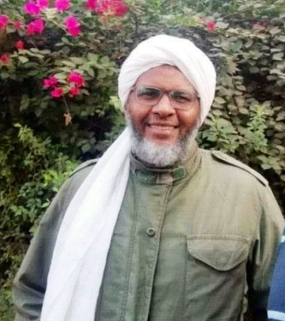
Abu Hudhayfa al-Sudani
Sudan as a Rising Arena of Activity for al-Qaeda Supporters
In 2022, even before the outbreak of the civil war in Sudan, al-Sudani published two treatises regarding the importance of fulfilling the obligation of jihad against the Sudanese regime, arguing that Sudan operates under a civil governance system that deviates from the principles of the Islamic religion. Hence, one must strive to overthrow it and establish a regime based on Sharia in its place. Below are his writings on Sudan:
- “The Forgotten Emir” (February 2022, 64. pp): In this treatise, al-Sudani calls upon al-Qaeda supporters to exploit the security instability in Sudan to establish an operative infrastructure that will assist in creating jihad cells and fighting the infidel Sudanese regime.[12] In his view, the primary obstacle facing dedication to jihad in Sudan is related to the absence of a charismatic leader of stature. In his view, Sheikh Abu Musab al-Zarqawi (then leader of al-Qaeda’s branch in Iraq, 1966-2006) is considered a good example of an ideal jihad leader who gradually transformed from an ordinary person into a resolute leader as a result of his time in a Jordanian prison.[13]
Al-Sudani even proposes a strategy for managing jihad in Sudan inspired by the thought of Sheikh Abu Musab al-Suri:
- Establishing rear bases and camps in remote areas such as mountains, forests, and deserts as a guarantee for the success of the struggle.[14] In his view, a rear base should provide the following conditions: ease of entry and exit; continuous and regular water supply; the ability to defend the base during an attack; the possibility of withdrawal when necessary; the ability to camouflage people and weapons; the enemy’s inability to launch a surprise attack on the base; and proximity or distance of the base from workplaces. He states that by establishing these bases, logistical and financial problems can be solved, inter alia, by seizing military convoys and adversary weaponry.
- Establishing decentralized urban cells within cities for the purpose of high-quality attacks and assassinations of military, security, and political leadership.
- Relying on a small, mobile, and elusive military structure to wage guerrilla warfare.
- Concentrating efforts to strike financial companies in Sudan that serve as a source of funding for the Sudanese army. In his view, paralyzing their activity will lead to the severing of funding pipelines for the military apparatus and its collapse.[15]
In al-Sudani’s view, the Afghan fighting model-expressed in the establishment of bases in the mountains can serve as a good example for the Mujahideen in Sudan. However, al-Sudani believes that the success of jihad in Sudan is tied first and foremost to the willingness to emigrate from Khartoum, the capital of Sudan, and to psychological and physical readiness to live in mountains and forests.[16]
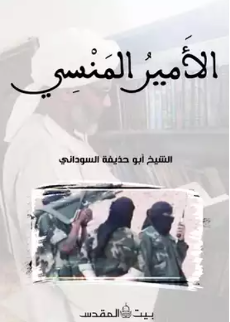
Cover of “The Forgotten Emir”
- “Now Comes the Killing” (October 2022, 83. pp): In this book, al-Sudani echoes many of the points he mentioned in “The Forgotten Emir”. Thus, he calls once again for the establishment of a jihadist vanguard corps in Sudan. In his view, two main factors can contribute to the successful entrenchment of jihad organizations in Sudan based on al-Qaeda’s past experience in Tunisia, Mali, Yemen, and Syria: the first factor is closely tied to a broad grassroots support base and the mobilization of public support through preaching and propaganda; and the second factor relates to clear leadership with a strategic vision. According to his method, the success of jihad in Sudan is tied to the desire and mental and physical readiness of its inhabitants to leave a life of luxury and emigrate from Khartoum to the mountains and forests.[17]
Regarding attack targets, al-Sudani clarifies that he adopts the guideline of al-Qaeda leadership published in 2013 under the title “General Guidelines for Jihad” by the organization’s leader, Sheikh Ayman al-Zawahiri. According to these, focus should be placed on military, security, and political targets.[18] Al-Sudani added economic targets to them as well, arguing that the military mechanism is funded in part by financial companies associated with Sudanese military figures; striking these companies, he claims, will help paralyze the activity of the Sudanese army and assist in funding jihad activity. Therefore, a list of financial companies in Sudan should be prepared and efforts concentrated on striking them.[19]
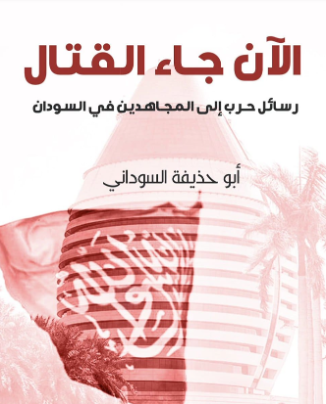
Cover of the Book “Now Comes the Fighting: Combat Letters to the Mujahideen in Sudan”.
- A Brief Epistle to Veteran and Pure-Handed Jihad Fighters (July 2026, 40. pp):[20] In this epistle, al-Sudani clarifies that jihad against infidels and deviant sects is a commandment incumbent upon every Muslim for the duration of their life, and whoever abstains from it sins grievously. He states that all fighters who previously fought in Afghanistan, Chechnya, Iraq, Syria, and other arenas cannot dwell on their past and surrender to civilian life, work, and family. On the contrary, he asserts that the work is not yet finished, and veteran jihadists, despite their advanced age, must renew jihad activity in the face of new challenges. Al-Sudani also appeals to the younger generation, urging them to stop watching screens and social media, and to begin practical military training, emigrate to combat zones, or carry out attacks on their own soil. In his view, the plagues afflicting Sudan stem from the lack of implementation of Sharia, and the only way to implement it is through jihad against tyrannical rulers (the “near enemy”), which he argues is anchored in Islamic jurisprudence.
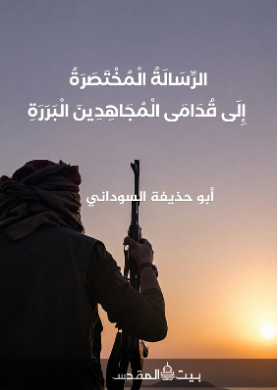
Cover of the publication “An Abridged Epistle to the Veteran and Upright Mujahideen”
- A Fighter from Khartoum: Words on Jihad, Brotherhood, and Love (July 2026, 137 pp.):[21] At the beginning of the book, al-Sudani notes that Muslims are currently engaged in a struggle against a unified enemy on several fronts, with the US leading a front of unbelief aided by pro-Western Muslim regimes in the Middle East-dubbed “agents of the West” – to consolidate its influence on Muslim lands by fighting true Islam, spreading secularism, separating religion from state, corrupting, and plundering resources. He also rails against the Sudanese regime, defining it as a secular regime under an Islamic guise that is linked to the infidel international system and cooperates with Western intelligence agencies like the US and France within the framework of the “War on Terror”. In his book, he also accuses political and institutional Islam in Sudan (meaning, among others, supporters of the Muslim Brotherhood movement) of betrayal for compromising on fundamental principles of Islam and cooperating with the Sudanese regime.
Al-Sudani warns that the war in Sudan is not going to end soon and will continue to experience a humanitarian disaster. However, a missed strategic opportunity is clearly evident here to establish struggle footholds in Sudan. In light of this, al-Sudani calls upon the younger generation in Sudan not to stand idly by, but rather to organize within military frameworks and exploit the lack of governance to establish an Islamic state.
In his view, guerrilla warfare and a prolonged war of attrition are the best ways to defeat the enemy on its own turf and dismantle the international system. Victory over the enemy will not be achieved in a single campaign but in a long series of campaigns that will exact heavy casualties, similar to the long campaign waged by the Muslims against the Crusaders who invaded Islamic lands. He argues that the mere ability to penetrate the enemy’s security arrays and carry out attacks constitutes a psychological victory. He claims that the jihadist current is the only Islamic force capable of confronting the front of unbelief through jihad and sacrifice, while religious scholars have an important role in justifying this war.
Consequently, al-Sudani recommends conducting two main stages of fighting in Sudan: the first stage is fighting alongside the public, defending it and its property, with the aim of broadening the support base; the second stage is transitioning to the struggle for the establishment of an Islamic state and the implementation of Sharia.
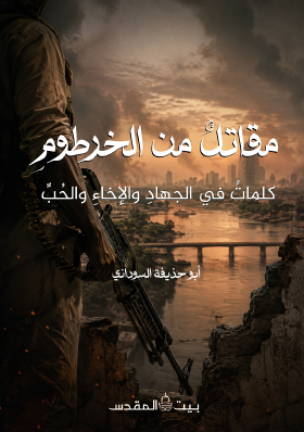
Cover of the book A Fighter from Khartoum
Discussion and Conclusions
The continuation of the civil war and the absolute lack of governance in Sudan are not merely local humanitarian tragedies but constitute a strategic window of opportunity for global terror organizations, foremost among them al-Qaeda. The repeated calls of ideologue Abu Hudhayfa al-Sudani to exploit the diverse local topography (mountains, forests, and isolated desert areas) to establish rear bases indicate a tangible danger of “Afghanization” in the Sudanese periphery. Al-Qaeda views this space as fertile ground for establishing regional terror incubators, while applying operational lessons accumulated in other arenas.
Moreover, al-Sudani’s analysis reveals an intellectual evolution combining classical guerrilla warfare with strikes against the economic home front of the Sudanese regime. The emphasis he places on designating financial companies and military funding sources as attack targets indicates an ambition to disrupt the army’s oxygen pipelines and undermine its institutional stability from within.
Looking ahead, the greatest threat lies in the integration of terrorist elements into the contemporary technological warfare equation. The leakage of knowledge, weaponry, and unmanned tools-such as drones and UAVs distributed in massive quantities during the current civil war-into the hands of terrorist elements could dramatically upgrade al-Qaeda’s operational capabilities at a relatively low cost. Such a development will not remain confined within Sudan’s borders. It will amplify the potential threat to maritime trade routes in this strategic region, transforming the country from an intra-state friction point into a hub for regional and international terror export.
[1] Mashari al-Dhaidi, “Al-Qaeda Organization in Sudan… When?” [Arabic], al-Sharq Al-Awsat, May 2, 2023.
https://aawsat.com/home/article/4307291/مشاري-الذايدي/«تنظيم-القاعدة»-بالسودان-متى؟
[2] During the first three weeks of October 2026, several drone strikes resulted in the deaths of 306 Sudanese people and injured hundreds more. For example, on 21 October, 153 people were killed in a drone strike, while on 27 October 2026, more than 100 people were also killed in a drone strike. “UN rights chief says drone strikes killed 306 Sudanese in October”, Sudan Tribune, 25 October 2026. https://sudantribune.com/article/320387; Yassir Abdallah, “More than 100 people killed in Sudanese army drone attack on market says Sudanese rights group”, APM, October 27, 2026. https://apnews.com/article/sudan-power-outage-capital-drone-0798818d82bc79ed10300687a514c693
[3] “Sudan Situation”, UNCHR, Sep 2026. https://data.unhcr.org/en/situations/sudansituation/location
[4] “Sudan: External support networks are fueling conflict and civilian harm, UN Fact-Finding Mission warns”, United Nations Office of the High Commissioner for Human Rights, September 3, 2026. https://www.globalsecurity.org/military/library/news/2026/09/mil-260903-ohchr01.htm
[5] Mahder Nesibu, “Making Sense of the Alignment Between Eritrea and the Sudanese Armed Forces”, Horn Review, August 18, 2026. https://hornreview.org/2026/08/18/making-sense-of-the-alignment-between-eritrea-and-the-sudanese-armed-forces
[6] Hanna Duggal and Marium Ali, “The drones being used in Sudan: 1,000 attacks Since April 2023”, al-Jazeerah, 3 February, 2026. https://www.aljazeera.com/news/longform/2026/2/3/drone-warfare-in-sudan-tracking-1000-aerial-attacks-since-april-2023
[7] Abu Hudhayfa al-Sudani, The Forgotten Emir [Arabic], Bayt al-Maqdis, February 2022, pp.10-11.
[8] Abu Hudhayfa al-Sudani, A Warrior from Sudan [Arabic], Bayt al-Maqdis, July 2026, p.57.
[9] Al-Sudani, A Warrior from Sudan [Arabic], p.88.
[10] Al-Sudani, The Forgotten Emir [Arabic], p.112.
[11] Al-Sudani, The Forgotten Emir [Arabic].
[12] Al-Sudani, The Forgotten Emir [Arabic], pp.21-22.
[13] Al-Sudani, The Forgotten Emir [Arabic], pp.23-25.
[14] Al-Sudani, The Forgotten Emir [Arabic], pp.31-32, p.34.
[15] Al-Sudani, The Forgotten Emir [Arabic], pp.31-32, p.26.
[16] Al-Sudani, The Forgotten Emir [Arabic], p.41.
[17] Abu Hudhayfa al-Sudani, Now Comes the Killing:Combat Letters to the Mujahideen in Sudan [Arabic], Bayt al-Maqdis, October 2022, pp.42-43, p,48, pp.70-71.
[18] Al-Sudani, Now Comes the Killing [Arabic], pp.42-43, p.48, pp.70-71.
[19] Al-Sudani, Now Comes the Killing [Arabic], p.53.
[20] Abu Khudhayfah al-Sudani, An Abridged Epistle to the Veteran and Upright Mujahideen [Arabic], Bayt al-Maqdis, July 2026.
[21] The book comprises a collection of articles written following al-Sudani’s release from prison and against the backdrop of the civil war in Sudan. Abu Khudhayfah al-Sudani, A Fighter from Sudan [Arabic], Bayt al-Maqdis, July 2026.