
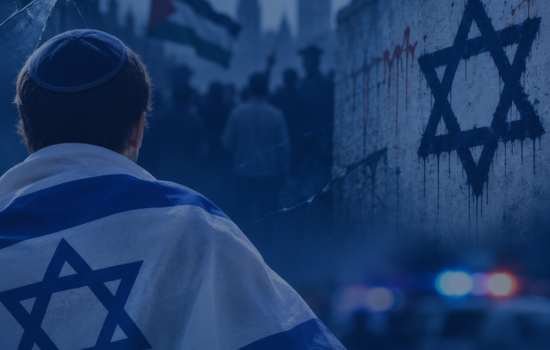
Antisemitism: Trends, Threats & Responses October 2026 | Insights from the ICT Global Extremism & Antisemitism Desk
From the Desk
October marked the third anniversary of the October 7 Hamas massacre. Jews were attacked in ordinary public settings, Jewish schools and synagogues faced threats and attacks, and Jews were pushed out of professional and cultural life over their real or perceived ties to Israel. The month also brought the UAE’s finding that the September 30 attack on a Flydubai flight to Tel Aviv was a planned suicide attack on Ben Gurion Airport.
In Britain, official figures published on October 8 recorded 3,162 anti-Jewish hate crimes in England and Wales between April 2025 and March 2026, a 10% rise on the previous year and the highest rate per person of any religious group.
Online, monitored content questioned whether Jews are Jews at all and described them in biological terms, as an invasive species or a contaminating bloodline. Across settings, Jews were targeted as individuals recognized in public, as communities through their institutions, and as people asked to answer for Israel before taking part in public life.
Dr. Liram Koblentz-Stenzler
Head of the Antisemitism & Extremism Desk
International Institute for Counter-Terrorism (ICT)
Key Trends
Trend 1: Antisemitic Violence in Everyday Public Spaces
Jews were attacked while walking through streets, working and carrying out other ordinary activities. As in previous months, several incidents began outside Jewish institutions or organized events.
In London, three Jewish women were assaulted in Stamford Hill on October 19, including a mother pushing a baby in a pram. Police investigated the incidents as suspected antisemitic hate crimes, and a man charged with three counts of assault by beating pleaded not guilty. In New York, federal prosecutors charged a woman on October 29 with two hate crimes over attacks on two Jewish men near Manhattan’s Diamond District on October 21, in which one victim was jabbed with a needle and another stabbed in the forearm. According to the criminal complaint, the attacks followed questions about the victims’ religious identity. Prosecutors also linked her to a June 2025 assault on a Jewish man outside a yeshiva in Brooklyn.
In Berlin, police investigated an assault on a 60-year-old man as a suspected antisemitic attack. A separate police report described repeated attacks on a shopkeeper after he displayed posters opposing antisemitism around the October 7 anniversary.
Setting linked these cases. Each attack took place on a street or in a shop, during routine activity, against people identified as Jewish or, in the Berlin shopkeeper’s case, against someone who publicly opposed antisemitism. Security planning built around synagogues and community buildings leaves these everyday spaces largely outside its reach.
Trend 2: Threats and Intimidation Against Jewish Communal Life
Threats and hostile messages affected Jewish schools, religious institutions and nearby neighborhoods. These incidents disrupted the places where people learn, worship and gather.
On October 12, hoax bomb threats disrupted Jewish schools in California and Florida. In Belleville, Ontario, police investigated antisemitic flyers distributed in the city. The president of the Sons of Jacob Synagogue reported that the material also reached the synagogue and surrounding neighborhoods, less than a month after a gunman exchanged fire with police outside the building on Yom Kippur, seriously wounding an officer while about two dozen people were inside.
In Los Angeles, the FBI arrested a 51-year-old man in mid-October over threats against JEMS, a Chabad-affiliated Jewish preschool. According to the federal complaint, he had posted in September that he “might bomb JEMS later,” praised the Houthis and called for burning synagogues. Agents searching his home found materials believed to be intended for incendiary devices.
In Kochi, India, police arrested a man within hours of an October 12 arson attack on a nursery run by the Kadavumbhagam Synagogue. Police suspect he acted on orders from a handler he called his “boss,” who chose the targets, and are checking whether he was paid, possibly in cryptocurrency, for the attack and for filming it. The case is now under a terrorism investigation that includes possible foreign links. The pattern resembles the attacks on Jewish sites in Europe described in the April report, in which remote handlers paid local individuals to carry them out.
Antisemitic intimidation also appeared in public messages. Graffiti in Rome called for Jews to leave European countries and included neo-fascist symbols. In Split, Croatia, football supporters used antisemitic and pro-Nazi chants before a match against Ajax.
The threats differed in severity, from hoax bomb calls and antisemitic flyers to threats against a Jewish preschool and an arson attack under investigation as part of a wider conspiracy. Their effect on Jewish communal life was similar: lessons were interrupted, buildings evacuated and security reviewed, and families had to decide whether to return. Intimidation achieves its purpose once Jewish institutions must operate under constant threat assessment, whether or not anyone is harmed.
Trend 3: Exclusion Linked to Support for Israel
In October, Jewish professionals and people working to protect Jewish communities were turned away from ordinary activities, or admitted only on political conditions, because of their real or perceived ties to Israel.
In Italy, about 100 Jewish preschool educators from the United States and Israel cancelled a study trip to Reggio Emilia, home of a well-known approach to early childhood education. After local parents protested the educators’ alleged support for Israel, the host organization asked participants to sign a statement distancing themselves “from the occupation of Gaza.” Participants also said their names had been made public and their social media reviewed. The hosts later disputed that signing was a formal requirement, and the city gave assurances that Jewish educators could visit without political conditions.
In London, Jewish comedian Harry Deansway was removed from a writing group he had attended for six months after telling its organizer that he was a Zionist who also supported Palestinian rights. According to UK Lawyers for Israel, she told him his beliefs “support the massacre of an entire population,” said there was no place for him in the group and announced that prospective members would have to commit to an apartheid-free space. She also allegedly told him that Jews, given their own history, should not want to cause others such suffering. UK Lawyers for Israel warned that the removal may breach Britain’s Equality Act. The organizer declined to comment.
In Dublin, according to the chairman of the Jewish Representative Council of Ireland, a hotel cancelled a 70-room booking for European Union envoys attending a meeting on combating antisemitism once it learned the purpose of their visit. He said hotel management had also asked whether the event was linked to the Israeli military. The delegates moved to another hotel.
In each case, taking part came with a political test. The people affected had no part in Israeli decision-making, yet they were asked to distance themselves from Israel, or to answer suspicion of ties to it, because they were Jewish or because they worked on behalf of Jews.
Campus Environments and the Normalization of Antisemitism
Jewish students faced hostility in their residences, in shared campus spaces and at Jewish community events.
Toronto Metropolitan University announced on October 2 that it was investigating reports of antisemitic vandalism in a student residence. The university involved its human-rights and student-support teams. At the University of Pittsburgh, campus police received two reports of antisemitic graffiti between October 12 and 15.
In Oregon, Hillel International reported posters targeting its executive director and calling for Hillel’s removal from campus. It also reported that protesters burned American and Israeli flags outside Hillel House while Jewish students commemorated October 7. A separate incident involved the theft of a sukkah at Oregon State University.
At Swarthmore College, the U.S. Department of Education expanded an existing antisemitism investigation following the reposting of a video showing an Israeli soldier being burned in effigy. The college disputed the basis for the expanded investigation. It said the group associated with the account had lost recognition in 2025 and that the account’s current operators were unknown.
On October 19, the University of North Carolina at Chapel Hill reached a settlement with the Justice Department that closed 18 federal civil rights investigations. Under the agreement, the university will appoint an official to handle antisemitism complaints, train students and staff on antisemitism and ban face coverings that hide identity.
Calls to remove Hillel targeted the main institution through which Jewish students take part in campus life, aiming at Jewish organizational presence itself rather than at Israel or its policies. Federal enforcement continued through investigations and negotiated settlements, while universities contested responsibility for conduct by unrecognized or anonymous groups.
Key Incident | Flydubai Flight FZ1073
On September 30, the co-pilot of Flydubai flight FZ1073 from Dubai to Tel Aviv attacked the captain with the cockpit’s emergency axe while the aircraft was in Saudi airspace. A pilot travelling on board, a cabin crew member and several passengers, including Israelis, restrained him, and the replacement crew diverted the aircraft to Tabuk, where it landed safely.
On October 9, UAE Attorney-General Hamad Saif al-Shamsi announced the findings of the investigation. According to prosecutors, the 29-year-old Omani co-pilot planned to seize the aircraft and crash it into the passenger terminal at Ben Gurion Airport in a suicide attack modeled on September 11. He had flown the route twice beforehand to study it, and prosecutors traced his exposure to takfiri ideology, through extremist literature and online content glorifying suicide attacks, to 2017. He confessed and said he acted alone. The investigation into possible accomplices continues, and officers of the Israel Security Agency (Shin Bet) joined the interrogation in the UAE.
The case exposes an insider threat that passenger screening is built to miss. The co-pilot passed Flydubai’s recruitment checks, including a certificate of good conduct, although Oman Air had reportedly barred him from flying over his extremist views. Israeli aviation security has concentrated on passengers and baggage. After the attack, Israel’s passenger data authority ordered carriers to submit crew details 48 hours before departure, Prime Minister Benjamin Netanyahu acknowledged “a loophole,” and Flydubai suspended flights to Israel during the investigation.
The choice of target carries its own significance. The Dubai to Tel Aviv route is among the most visible civilian products of the Abraham Accords, and the planned strike on Israel’s main international gateway would have turned that connection into a site of mass casualties. The case also shows how violence against Israelis is first described. Flydubai’s initial statement referred to “an altercation” in the flight deck; the prosecutors’ findings describe a premeditated, ideologically driven plot. That gap between first framing and established fact is the subject of the Desk’s October 5 analysis in the Washington Examiner.
Online Dynamics | October 2026
ICT monitoring in October identified familiar antisemitic ideas attached to discussions of Israel, religion, migration and international events. The pattern matches the Online Hate Prevention Institute’s quarterly analysis, published in mid-October, which found that classic tropes of Jewish power, blood libel and collective guilt for the death of Jesus remained the dominant category on most of the 11 platforms it monitors.
Trend 1: Denying Jewish Identity
Content monitored in October claimed that many Jews are not really Jewish. The claim drew on ideas from opposite ends of the political spectrum. From the far right came a genealogical argument: a video by a Christian nationalist pastor asserted that Jews are not Israelites, Hebrews or Semites, and other posts invoked the “Khazarian mafia” conspiracy narrative, which casts today’s Jews as impostors descended from a converted Turkic people. From anti-Zionist discourse came a political test: posts presented Jews who oppose Israel as the “real Jews” and labeled Israel’s supporters “fake Jews.” Some posts merged the two, calling Israeli leaders “satanic fake Jews.”
The two currents start from different premises and reach the same result: outsiders decide who counts as a Jew. The far-right version denies that Jews are Jews at all. The anti-Zionist version accepts some Jews, on condition that they reject Israel. Where the two meet, a position on Israel becomes the entry point to older religious and racial tropes.
Trend 2: Blaming Jews for Political and Social Crises
Unrelated events were presented as stages of a single hidden Jewish plan. Videos and posts recast the war in Ukraine as a Jewish takeover project, Jewish contributions to civil rights, racial justice and gay rights as an admission that Jews stand “behind every evil,” Jewish religious language about peace and redemption as approval of unrest in France, and migration into Europe as the work of Jewish organizations. Material circulating as a supposed Jewish “confession” claimed Jewish control of banks, the media and governments, placing the accusations in the mouth of a Jew so that they read as an admission.
Whatever the event, Jews were cast as the cause of other societies’ crises. Some posts went further and argued that voting and ordinary politics cannot solve the problem, a message that points readers toward action outside the political system.
Trend 3: Biological Framing of Jews
Far-right online spaces described Jews as a separate biological group rather than as a religion or a people. Three claims recurred. Jews were called “an invasive species,” as if they were a pest that the land itself rejects. The Holocaust was described as a filter that killed “low-tier” Jews and left a surviving “elite,” with Jewish success explained by “selective breeding.” Jewish ancestry was treated as contamination, and other groups, such as Poles, were dismissed as “hybridized with jews.”
Defining Jews by blood rather than by belief or behavior makes Jewishness permanent and inescapable, and allows violence against Jews to be presented as nature taking its course.
Responses and Regulatory Developments | October 2026
October’s responses combined accountability for past attacks with structural measures in education, security funding and party politics.
In the United Kingdom, the Home Secretary announced a public inquiry on October 12 into the deaths of two men in the 2025 Heaton Park synagogue attack. The inquiry would allow sensitive national-security evidence to be examined. Her statement also described additional police funding already provided to protect Jewish areas and address antisemitism.
On October 21, the government accepted all 27 recommendations of the independent review of antisemitism in schools and colleges led by Sir David Bell, former Chief Inspector of Schools. The review found that 59% of Jewish respondents aged 16 to 19 had experienced antisemitism, drawn from a small Jewish sample, and that 51% of Jewish teachers had faced antisemitism at work in the previous year. Measures include staff training, clearer guidance, better incident reporting and support for institutions. An implementation group was established, and Bell was asked to review progress after one year.
On October 14, Prime Minister Andy Burnham condemned as antisemitic the Green Party’s conference resolution defining Zionism as racism and ruled out a partnership with the party while it retained that position. The Greens rejected his characterization.
In the United States, California’s Legislative Jewish Caucus announced on October 1 that Governor Gavin Newsom had signed six priority bills into law. The package addressed access to houses of worship, security funding for nonprofit events, workplace training and recognition of Jewish identity in state ethnicity data. The announcement also reported an ongoing annual allocation of $80 million for nonprofit security grants.
In Utah, a federal grand jury indicted a man on October 21 on charges including attempting to commit a hate crime and making explosive threats against a synagogue. Authorities reported finding weapons and explosive devices. The alleged threats dated to December 2025; the indictment was an October development in the case.
In France, authorities began proceedings to dissolve Égalité et Réconciliation, the organization led by Alain Soral. Reporting on October 12 described an ongoing consultation process concerning the organization and its antisemitic and conspiratorial material. Dissolution had not been completed at that stage.
In Germany, Hamburg’s Higher Regional Court sentenced two men on October 15 to eight and a half and four and a half years in prison for plotting, on the orders of Iranian intelligence operatives, the assassination of Josef Schuster, president of the Central Council of Jews in Germany, and Volker Beck, president of the German-Israeli Society, as well as arson attacks on Jewish and Israeli targets. One of the men was also convicted of surveilling a Jewish grocery store in Berlin. Germany summoned Iran’s ambassador, and Iran rejected the accusations.
In Italy, police arrested two men on October 29 over an August 14 assault on a historian of European Jewish communities near Rome’s Great Synagogue. Investigators from the police unit for politically motivated crime identified the suspects from surveillance footage, and both face charges of racially motivated attempted aggravated robbery.
In Ireland, special envoys and coordinators combating antisemitism from European Union member states met in Dublin from October 12 to 14, with sessions on online hate, artificial intelligence and cooperation with technology companies. The meeting went ahead after the Dublin hotel cancellation described above, which placed the delegates themselves inside the pattern they had gathered to address.
Recent Analysis from the Desk
Flydubai Flight 1073 and the Normalization of Terror
In an October 5 Washington Examiner article, Dr. Liram Koblentz-Stenzler and Bradley Martin examine the attack aboard Flydubai Flight 1073 and the early reports that reduced it to a cockpit “dispute.” They argue that minimizing violence against Israelis opens space for conspiracy claims that Israel exaggerated the attack, recasting the victims as manipulators. The article places the attack on a Dubai to Tel Aviv flight, a product of the Abraham Accords, within a wider rise in physical antisemitic violence, and warns of lone actors who absorb ideological justifications for violence without recruitment or instructions from any organization.
Antisemitism, Jewish Identity and Relations with Israel
In an October 23 Maariv article, Dr. Liram Koblentz-Stenzler examines how antisemitism and pressure over ties to Israel affect Jewish identity and belonging. She discusses how individual Jews are held responsible for Israeli actions and how those experiences can weaken or strengthen attachment to Israel. The article calls for sustained investment in relations with diaspora communities, especially younger generations.


