
The Paradox of Power: Military Might and Negotiating Weakness in the October 7 Hostage Crisis
Executive Summary
The hostage crisis precipitated by the October 7, 2023 attack was unprecedented in its scope, complexity, and strategic significance. Israel was confronted with the dual necessity of securing the release of hundreds of hostages held by Hamas while concurrently waging a war to dismantle the group’s military and governing capabilities. While both objectives were vital, they rested on distinct and often conflicting strategic logics. Military decisiveness typically demands time, force, and unyielding resolve, whereas the recovery of hostages necessitates speed, flexibility, and the swift exploitation of fleeting windows of opportunity.
The government policy regarding the recovery of the hostages served as the primary shaping variable governing the retrieval effort and its outcomes. In its initial formulation of war aims, the War Cabinet defined the hostage-related objective merely as “creating the conditions for the return of the hostages”. In subsequent months, however, political leaders publicly framed the recovery of the hostages and the dismantling of Hamas as two parallel, coequal war objectives.
The gap between the formal definition of the objective and its public presentation was far from semantic, it carried profound strategic implications that shaped the entire campaign, delineated the bargaining space and the terms of negotiation, and dictated trade-offs between sustained combat operations and reaching an agreement with the enemy to secure the hostages’ release.
This article, however, does not seek to adjudicate whether the policy established by the political leadership was correct, nor does it examine the underlying motives or political considerations behind it. Instead, its focus lies squarely on the professional tier operating beneath these political decisions. How policy was translated into negotiation strategy, how the mandate granted to negotiators constrained or enabled the process, how the negotiating team and mediation framework were structured and managed, and how levers of military pressure, time, and intelligence were deployed to advance negotiations.
The central question of this article is whether, given the government’s policy and its attendant constraints, did Israel’s negotiating apparatus effectively maximized the nation’s strategic assets to secure the return of the hostages?
The article contends that it did not.
Despite overwhelming military, intelligence, and diplomatic superiority, unprecedented resource allocation, and extraordinary dedication by those tasked with the mission, Israel failed to translate its overarching national power into commensurate negotiating advantage.
The article identifies six fundamental failures that produced this outcome:
First, the mediation architecture. The multi-tiered mediation framework involving the United States, Qatar, and Egypt expanded access to Hamas and created channels of influence. However, it also distanced Israel from the primary locus of decision making in Hamas and transformed the mediators’ own geopolitical interests into decisive variables shaping the negotiations, alongside the interests of the belligerents themselves.
Second, the strategy of “negotiating under fire”. This approach remained the guiding doctrine of the negotiation effort long after military pressure had degraded as an effective lever at the negotiating table. While military pressure was an essential component that contributed, alongside Hamas’s own interest in releasing women and child hostages, to the initial November 2023 agreement, Hamas adapted to this pressure as the war dragged on, even as constraints on Israel’s ability to sustain it mounted. Military operations continued to achieve tactical milestones on the battlefield, yet their utility in generating negotiating advantage and compelling Hamas toward an agreement progressively diminished.
Third, the strategy of partial agreements. While phased or partial deals succeeded in securing the early release of certain hostages, each successive agreement made subsequent deals significantly harder to achieve. The partial concessions Israel was willing to offer in subsequent rounds addressed fewer of the strategic objectives sought by Hamas, most notably an end to the war and a full IDF withdrawal. Consequently, the Zone of Possible Agreement (ZOPA) continually shrank, substantially prolonging the overall recovery effort.
Fourth, the structure of the negotiating team. The inclusion of the heads of the Mossad, the Shin Bet (ISA), and a senior IDF general endowed the team with immense institutional weight, top tier intelligence, and direct access to decision makers. However, their competing organizational responsibilities, a tightly constrained mandate and the lack of specialized expertise in crisis negotiation, compromised their ability to function as a unified, professional, task dedicated negotiating unit. Selecting the most capable individuals from disparate organizations proved no substitute for assembling the team best equipped for the specific mission.
Fifth, responsibility without authority. While the negotiating team bore practical responsibility for advancing a hostage release agreement, it was denied the leeway required to conduct effective bargaining. Although strategic decisions rightfully remain the prerogative of political leaders, the team was repeatedly forced to seek renewed approval even for minor shifts in negotiating postures and concessions at critical junctures. This generated an acute disparity between the team’s accountability for outcomes and its authority to shape the path to reaching them. This gap undermined its flexibility, weakened its standing against Hamas and the mediators, and impeded its ability to seize real-time opportunities. Rather than negotiating with the adversary within predefined policy boundaries, the team was forced into a continuous secondary negotiation to secure its own operational mandate from the political echelon behind it.
Sixth, operating methodology. The negotiations lacked a systematic, proactive, and coherent methodology. Israel largely operated within a framework designed by external mediators, perpetually reacting to proposals, timetables, and initiatives introduced by others rather than driving the process itself. As a result, Israeli strategic initiative eroded. Time was not systematically utilized as a lever of pressure, progress and foot-dragging were not tied to structured incentives or penalties, and negotiation tactics were insufficiently deployed to shape Hamas’s calculus. In essence, Israel represented its positions within the negotiations but largely failed to manage the negotiation process itself.
The cumulative effect of these shortcomings is the structural disparity between Israel’s comprehensive military and national power against Hamas and its institutional inability to organize and translate that power into effective negotiating advantage. In future crises, Israel will not merely require greater force, expanded intelligence, additional mediators, or more senior officials, but it will require a permanent national capability for hostage crisis management, developed and institutionalized during routine peacetime.
The political echelon will naturally continue to define national purpose, strategic priorities, red lines, and acceptable concessions for hostage recovery. Beneath it, professional responsibility for managing the crisis must be centralized within a dedicated, specialized national mechanism that will translate policy into a single operational strategy and integrate all state efforts toward a common purpose: negotiations, intelligence, operations, diplomacy, legal affairs, strategic influence, communications, and the public arena.
The aim is not to consolidate all state agencies into a single bureaucratic body, but rather to establish unified professional leadership capable of orchestrating diverse national capabilities as an integrated system serving a single purpose.
Hostage terrorism crises share fundamental structural characteristics that permit the development of dedicated doctrine, specialized expertise, and tailored capabilities. Yet the next crisis will inevitably diverge from the Gaza hostage crisis. Preparedness, therefore, cannot consist of prefabricating answers to the previous dilemma, it demands building an enduring national capacity capable of confronting a crisis whose form, scale, and strategic circumstances cannot be foreseen.
The cumulative lesson of the October 7 crisis, compounded by Israel’s decades of experience with hostages, is that national power does not automatically translate into negotiating power.
The ability to convert military might, intelligence supremacy, diplomacy, and strategic influence into effective negotiating advantage against a terrorist organization must be systematically constructed, trained, and rehearsed during peacetime.
While the next hostage crisis cannot be predicted, the institutional capabilities required to bring hostages home safely must be built in advance.
Introduction
On October 7, 2023, Israel faced one of the most severe national security crises in its history. The Hamas assault on the southern communities was not merely a large-scale terrorist attack and war, it was an event of profound strategic, national, and psychological resonance. Hundreds of civilians and soldiers were abducted into the Gaza Strip, plunging Israel into a hostage crisis unprecedented in its scale, complexity, and impact on Israeli society and the national decision-making apparatus.
As the military campaign against Hamas progressed, Israel increasingly confronted a fundamental strategic dilemma. How to dismantle Hamas’s military and governing apparatus while concurrently securing the swift and safe return of the hostages held in its captivity.
In the War Cabinet’s decision of October 16, 2023, the recovery of the hostages was not defined as an independent war objective, but rather, the objective was framed as “creating the conditions for the return of the hostages to Israel”, alongside the destruction of Hamas’s military, governmental, and organizational capabilities. Nevertheless, since late 2023, political leaders publicly stated that retrieving the hostages and dismantling Hamas constituted two central and concurrent war objectives[1].
Both objectives were legitimate and vital. However, the government’s initial decision not to designate the recovery of the hostages as an independent war aim, followed by its subsequent presentation as an objective coequal to the dismantling of Hamas, generated an inherent tension between two divergent strategic logics: the logic of military decisiveness and the logic of hostage recovery.
These two logics operate according to fundamentally different rules, timelines, and metrics of success. The logic of decisiveness seeks to apply sustained force over time to wear down the adversary and consolidate military gains. Conversely, the logic of recovery seeks to utilize force as a lever to be swiftly converted into an agreement before it degrades and before the peril to the hostages escalates. In military decisiveness, time and rigidity can amplify pressure on the enemy. In hostage negotiations, they risk constricting the bargaining space and shuttering windows of opportunity.
What serves to achieve victory on the battlefield does not necessarily advance the recovery of hostages at the negotiating table.
The core problem lay not in the mere establishment of dual war objectives, but in the absence of an overarching strategy governing how to adjudicate between them when they inevitably clashed. Lacking clear priorities and decision rules, a strategic paradox emerged. Advancing one objective risked compromising the attainment of the other.
This paradox profoundly shaped the hostage recovery effort. Israel’s military, intelligence, and diplomatic superiority was not translated into commensurate negotiating superiority. The crisis dragged on, the price of securing the hostages’ return rose, and additional hostages perished in captivity.
The objective of this article is neither to evaluate the motives of decision-makers in formulating the war’s aims nor to pass retrospective judgment on specific tactical errors made amid the fog of war and uncertainty. Rather, its purpose is to examine the Israeli hostage recovery effort as a strategic crisis negotiation system, and to evaluate whether the negotiating mechanism was fit for purpose and enabled Israel to fully capitalize on its national power.
The analysis focuses on the foundational assumptions, key decisions, and operational patterns that defined the effort. Its goal is not to litigate the past, but to draw actionable lessons for the next hostage crisis.
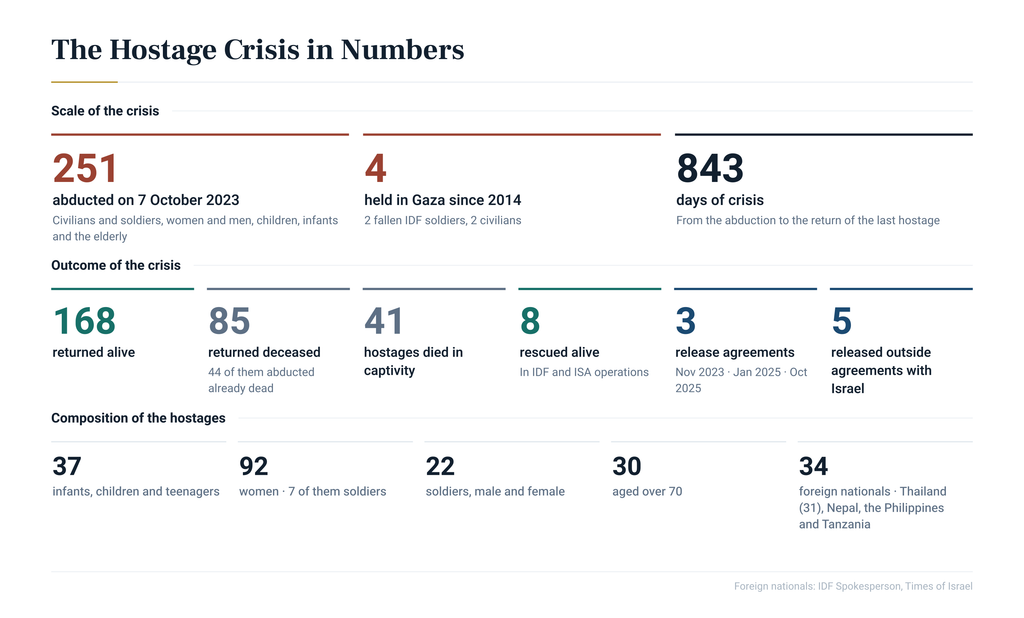
Nothing in this analysis diminishes the extraordinary magnitude of the national recovery effort. Those entrusted with the mission operated with profound dedication under unprecedented conditions, mobilizing vast resources and capabilities. At the end of 843 days from the outbreak of the crisis, no Israeli hostages, living or fallen, remained in Hamas custody in Gaza. Their return represents a monumental national and moral achievement, reflecting the State of Israel’s deep commitment to its people.
Deriving lessons from this crisis is a continuation of that very same commitment, ensuring that in the next crisis, Israel will be equipped to bring its people home swiftly, safely, and in a manner that safeguards the vital strategic interests of the state.
Table 1:
The Strategic Background to the Hostage Crisis
The Hamas assault of October 7, 2023, was the culmination of long-term strategic processes across the regional arena and the Gaza Strip, as well as a profound divergence in how Israel and Hamas interpreted one another and the emerging reality between them.
This perceptual divide shaped not only the trajectory toward war, but also the conduct of both parties throughout the ensuing hostage crisis.
In the years preceding the assault, Iran consolidated the “Axis of Resistance” as a coordinated regional network of organizations and capabilities designed to exert multi front pressure on Israel. While Hezbollah constituted the primary military pillar of this alignment, Hamas integrated into the axis as an autonomous actor whose military and strategic ties with Tehran and Hezbollah steadily deepened.
Following Operation Guardian of the Walls in May 2021, a pivotal shift crystallized within Hamas’s leadership, transitioning from a defensive deterrent posture to an offensive doctrine, and evolving from an ongoing, limited confrontation with Israel toward a broad strategic gambit designed to fundamentally rewrite the rules of engagement [2].
Documents seized in the Gaza Strip during the Swords of Iron campaign reveal that in the years leading up to October 7, Yahya Sinwar formulated operational scenarios for a comprehensive confrontation with Israel, actively seeking to enlist Iran, Hezbollah, and other Axis of Resistance actors into the campaign. These documents outline plans for a multi front assault calculated to inflict devastating military, economic, societal, and psychological blows upon Israel[3].
In launching the October 2023 offensive, Sinwar was not seeking another round of escalation governed by established rules of engagement. Rather, his objective was to shatter them entirely through a strategic assault that would fundamentally transform the balance of conflict between Hamas and Israel.
The Israeli Approach:
Containment, Deterrence and Tactical Understandings
Conversely, following Hamas’s violent takeover of the Gaza Strip in 2007, Israel adopted a strategic framework centred on threat management and deterrence rather than decisive defeat. Israel effectively acquiesced to Hamas’s continued governance in Gaza strip, seeking to restrain the group through a blend of military deterrence, defensive measures, limited rounds of fighting, and civilian and economic incentives.
At the foundation of this policy lay several core assumptions, the essence of which was that Hamas was a rational actor seeking first and foremost to preserve its rule, Israeli deterrence would restrain it from a broad confrontation, improving the economic and civilian reality in Gaza Strip would increase the cost of war for it, and preserving Hamas as a restrained governing address in Gaza served Israeli interests, including the differentiation between it and the Palestinian Authority.
This rationale yielded an Israeli doctrine aimed at keeping the threat from Gaza at a tolerable threshold, thereby avoiding the heavy costs associated with a full-scale conquest of the Strip and the toppling of Hamas rule.
A foundational instrument of this doctrine was the model of periodic “limited fighting rounds”: calibrated applications of military force intended to degrade Hamas’s capabilities, reestablish deterrence, and pave the way for a return to calm and renewed tactical arrangements. Operations Cast Lead (2008), Pillar of Defense (2012) and Protective Edge (2014) largely reflected this operational logic.
Alongside military force, Israel deployed civilian and economic levers designed to impose governance and financial penalties on Hamas should it violate the quiet, including the facilitation of commercial goods, work permits, direct cash transfers and civilian aid. Prolonged periods of calm were interpreted in Israel as validation of the premise that Hamas was deterred, rational, motivated by self-preservation, and acutely aware of the ruinous costs of war.
Hamas, however, interpreted and exploited this arrangement through an entirely different lens. While Israel viewed tactical arrangements as instruments of regional stabilization, Hamas utilized them as protective cover for military build-up and preparation for an expansive military campaign that transcended the limited rounds for which Israel had prepared.
A profound strategic asymmetry thus crystallized on the eve of October 7. Israel sought to preserve the established rules of engagement through deterrence and tactical arrangements, while Hamas systematically prepared to shatter those very rules under the cover of those very arrangements.
This dichotomy is equally critical to understanding the hostage crisis. The mass abduction was not merely a tactical by product of the assault, but an integral pillar of Hamas’s war strategy. Control over hundreds of captives afforded Hamas the ability to offset part of its military inferiority with substantial negotiating power, thereby influencing the course of combat operations and the terms of conflict termination, alongside securing the release of Palestinian prisoners.
This encapsulates the central paradox of this study. Over the course of the October 2023 crisis, Israel established military, intelligence, and diplomatic superiority over Hamas, yet struggled to translate these substantial advantages into effective negotiating leverage to secure the return of the hostages.
The Historical Context of Hostages between Israel and Hamas
Israel and Hamas entered the October 7 hostage crisis shaped by the cumulative experience of prior hostage episodes, which had solidified their respective strategic perceptions, expectations, and appraisals of captive value.
The first precedent was the Gilad Shalit affair. Hamas in Gaza held Shalit, an armoured corps soldier abducted on June 25, 2006, near Kerem Shalom, captive for 1,941 days. He was repatriated to Israel on October 18, 2011, in a deal brokered by Egypt with German involvement, under which Israel released 1,027 security prisoners in two phases.
The second episode began during Operation Protective Edge in 2014 and extended into the October 7, 2023 crisis. Hamas held the remains of two fallen IDF soldiers, Lt. Hadar Goldin and Staff Sgt. Oron Shaul, alongside two living Israeli civilians who had crossed into Gaza Strip, Avera Mengistu and Hisham al-Sayed. Throughout the intervening decade until October 2023, Israel engaged in recurring efforts to retrieve the four, yet none of these initiatives bore fruit.
For both Israel and Hamas, these prior experiences served as a strategic learning laboratory from which each side drew diametrically opposed conclusions regarding the value of captives, the power of negotiation, and the doctrine for managing future abduction crises.
Hamas’s Doctrine: The Hostage as a Strategic Asset
An analysis of prior captive negotiations and internal Hamas documents captured during the war reveals three distinct layers of interest driving the organization’s retention of Israeli captives.
The practical layer – releasing prisoners, achieving civilian, economic, and other concessions.
The strategic layer – restricting Israel’s freedom of action and influencing its security and political decisions.
The perceptual layer – toward Israel, holding the hostages served as a component in the deterrence balance, an instrument for attrition and wear-down between rounds of fighting[4]. In the Palestinian arena, it bolstered Hamas’s standing through the ethos of the “Muqawama”-Resistance, and the struggle to release prisoners. In the regional arena, it contributed to strengthening its status and influence.
From Hamas’s perspective, Israeli societal sensitivity to the fate of its captives renders hostages a formidable asymmetric lever. By holding even a small number of captives, an organization militarily inferior to Israel can exert disproportionate strategic pressure and extract concessions far exceeding its relative combat power.
The Shalit deal demonstrated the immense potency of this lever to Hamas. The release of 1,027 prisoners in exchange for a single Israeli soldier proved, in the organization’s doctrine, that abduction was not merely an instrument of prisoner exchange, but an indispensable strategic weapon for altering Israeli calculus and securing concessions unattainable by other means.
Moreover, the five-plus years of Shalit’s detention provided Hamas with an equally vital lesson. An Israeli captive could be held over an extended period, and release refused, without imposing prohibitive military or strategic costs on the organization and its leadership. In the years preceding October 2023, Israel’s overarching interest in preserving regional and humanitarian stability in Gaza severely constrained the punitive measures it was willing to impose on Hamas for holding Israeli citizens.
Consequently, Hamas learned not only the exceptional bargaining value of captives, but also its ability to sustain that leverage over prolonged periods with relative impunity.
Israeli Doctrine: Abduction Terrorism is Not a Strategic Threat
The issue of prisoners and missing persons touches the deepest strata of the Israeli ethos. It is rooted in an ancient Jewish tradition of “Pidyon Shvuyim” (the redemption of captives) and mutual responsibility, as well as the ethos of solidarity forged within the IDF and Israeli society throughout the nation’s ongoing struggle for survival. From these collective foundations emerged an indelible national norm mandating responsibility for the recovery of soldiers and civilians held captive. Within Israel, the repatriation of captives is regarded not merely as a security mission or a utilitarian cost-benefit calculation, but as the supreme test of mutual guarantee, of public trust between the state and its citizens and between the IDF and its soldiers, and of overall societal resilience.
At the operational and strategic level, however, the hostage issue was historically treated in Israel not as an independent strategic threat in its own right, but primarily as a tactical-humanitarian and moral issue carrying derivative implications for broader strategic interests, such as deterrence, public trust in state leadership, and national resilience. This conceptualization persisted even though hostage-taking has never been a rare, sporadic occurrence, but an enduring feature of the confrontation between Israel and terrorist organizations. In the forty-five years between Operation Litani in Lebanon in 1978 and October 2023, IDF soldiers, fallen personnel, and Israeli civilians were held captive by terrorist organizations in Lebanon and the Gaza Strip for a cumulative period of approximately 33 years, representing roughly 73% of the entire era.
Even the 2011 Shalit agreement did not prompt Israel to construct a comprehensive new doctrine for countering abduction terrorism, but rather, Israeli institutional learning focused predominantly on the risks inherent in the deal itself. The extraordinary price paid and its subsequent security ramifications intensified the domestic debate regarding the acceptable limits of national concession, reinforcing fears that disproportionate exchanges would incentivize future abductions.
Consequently, an operational consensus crystallized among Israeli decision makers aimed primarily at preventing the recurrence of another “Shalit deal”. Similarly, in the decade long efforts to secure the release of the four Israelis held in Gaza since 2014, Israel focused on minimizing the concessions it would be required to yield, while failing to apply meaningful leverage to increase the ongoing price paid by Hamas for their detention.
Between October 2011 and October 2023, Israel concentrated on preventing the next Shalit deal rather than preparing for the next abduction crisis. Efforts were directed toward hardening concession policies and capping future prices, rather than formulating a comprehensive national doctrine to counter abduction terrorism or building dedicated national capabilities to manage such crises.
Thus, on the eve of October 7, an acute learning disparity existed between the two sides. While Hamas had come to perceive abduction as a decisive strategic weapon, Israel continued to treat it as an episodic crisis to be managed reactively, without an institutionalized national doctrine for its resolution.
The October 7 Hostage Crisis:
Unprecedented Complexity and Resource Mobilization
The hostage crisis in the Gaza Strip differed fundamentally from previous captive and missing persons episodes in Israel’s history. On the one hand, the sheer scope of the abduction, the heterogeneous composition of the captives, the grueling conditions of captivity, and the prolonged state of war created unprecedented complexity and acute operational risk. On the other hand, Israel commanded military, intelligence, diplomatic, and public strengths on an extraordinary scale never before available in prior captive crises.
The October 7 crisis thus unfolded within a foundational tension between extreme structural complexity and exceptional national capabilities to confront it.
Complexities and Constraints
- Number and composition of the hostages | Hundreds of hostages from diverse groups. Civilians and soldiers, women and men, children, the elderly, the sick, and the wounded.
The multiplicity of distinct groups created different bargaining values, degrees of urgency, risks, and interests for each group, complicating the formulation of a single framework for the return of all hostages and effectively turning a single abduction crisis into multiple separate negotiations within the same negotiating ecosystem.
- Ongoing risk to the hostages’ lives | The conditions of captivity, their medical condition, and the fighting in the areas where they were held turned time into a strategic variable. As captivity lengthened, the risk to the hostages’ lives increased and the timeframe for their return narrowed.
- Negotiation amidst war | Israel conducted negotiations with an organization that it was simultaneously seeking to decisively defeat militarily and governmentally. The two efforts influenced each other and at times collided, necessitating constant coordination between combat operations and negotiations.
- Expansion of negotiations to the strategic level | Hamas’s demands gradually expanded beyond a prisoner-for-hostage exchange deal to touch upon the core objectives and outcomes of the war: the cessation of hostilities, troop withdrawal, the future of Hamas governance, and the reconstruction of the Gaza Strip. Thus, negotiations for the release of hostages became a strategic arena over the terms of ending the war and shaping the post war reality.
- Dispute at the decision-making core | Managing the crisis within an emergency government, and subsequently within a coalition characterized by deep dispute regarding the prioritization among war aims, directly affected the decision-making mechanism itself. Coalition elements opposed deals they perceived as endangering the achievement of other war aims and even threatened to bolt the government if the war were halted within the framework of a deal. The dispute over the hierarchy of war aims permeated directly into the strategy and mandate of the negotiating apparatus, impacting Israel’s ability to formulate and maintain a consistent strategy for the return of the hostages over time, a stable mandate for the negotiating team, and clear manoeuvring room in dealing with Hamas and the mediators [5].
- Unprecedented media and public exposure | The crisis and the negotiations were conducted under continuous and intense media and public exposure. Positions, disagreements, framework details, red lines, and assessments of the parties’ stances were often leaked in real time, concurrently with the conduct of the process itself. The public arena thereby became part of the negotiating environment. it increased the pressure on decision makers and the negotiating team, narrowed the room for ambiguity and flexibility required for sensitive bargaining, and provided Hamas and the mediators with invaluable information. Thus, negotiations took place not only with Hamas and the mediators, but also across the media arena within Israel and abroad.
- Deep public rift | As the war dragged on, the tension between returning the hostages and continuing the fighting to dismantle Hamas became one of the central fault lines within Israeli society. The debate touched not only on the question of the price worthy of being paid in a deal, but on the priorities among the war aims and the question of which must prevail when tension arises between them. It increased pressure on decisionmakers and the negotiating team, constricted maneuvering room, and deepened the difficulty of maintaining a stable negotiation policy over time.
At the same time, Hamas identified the centrality of the hostage issue in Israeli society and acted to use it as a negotiating lever against the government and as a lever of psychological influence over Israeli society. Thus, the public rift in Israel was not merely a consequence of the hostage crisis but became a variable within the crisis that influenced freedom of action in managing it.
Strengths and Advantages
- Military power and operational presence on the ground | The war and the ground manoeuvre provided Israel with an unprecedented capability to apply direct pressure on Hamas, degrade its military capabilities and assets, collect intelligence, and generate opportunities for forcible hostage rescue operations.
- Direct pressure on Hamas leadership | Over the course of the war, Hamas’s senior military and governmental leadership echelon in the Gaza Strip was systematically targeted. The direct threat to their lives created an additional lever within the matrix of negotiation pressures and incentives [6].
- A powerful mediation framework | The continuous and unprecedented involvement of the United States, Egypt, and Qatar provided access to Hamas leadership, relatively continuous communication channels, and the capacity to apply pressure, offer guarantees, and support the formulation and implementation of agreements.
- Unprecedented seniority of the negotiating team | The involvement of the heads of the Mossad and the Shin Bet (ISA), alongside a senior IDF Major General, provided the hostage effort with direct access to all national intelligence, state resources, and decision-making centres, enabling strong integration across the diplomatic, intelligence, operational, and negotiating dimensions.
- A dedicated hostage intelligence apparatus | The establishment of a dedicated IDF headquarters to centralize all aspects of hostage intelligence. The headquarters comprised dozens of teams and hundreds of personnel from Military Intelligence (Aman), the IDF, and the Shin Bet, alongside advanced technology experts across diverse applications. The headquarters provided decision makers and the negotiating team with an intelligence baseline of exceptional scope that had never existed in previous Israeli hostage affairs [7].
- Broad public legitimacy for an agreement | As the war progressed, public opinion polls at various stages indicated broad public support for advancing a deal and prioritizing the return of the hostages, even when this entailed substantial concessions[8]. Israeli public opinion was thus simultaneously a source of pressure that constrained the government’s freedom of action and a source of legitimacy for advancing a deal[9].
- Broad international support at the beginning of the crisis | The massacre and mass abduction on October 7 generated significant international support for Israel at the outset of the war, recognition of its right to self defense, and widespread demand for the release of the hostages. This support was a strategic asset, expanding Israel’s diplomatic freedom of action and providing a basis for mobilizing diplomatic support for the hostage recovery effort[10].
However, as the military campaign expanded, casualties and destruction in the Gaza Strip mounted, and claims of a humanitarian crisis intensified, the focus of international discourse shifted gradually from the massacre and the hostages to the conditions of the population in Gaza, with increasing demands to restrict fighting, expand aid, and implement a ceasefire. Thus, international support transformed from a strategic asset at the beginning of negotiations into a strategic burden as they progressed[11].
The uniqueness of the October 7, 2023 hostage crisis was twofold. On the one hand, Israel faced the most complex abduction crisis in its history. On the other hand, it commanded the broadest and most powerful national toolkit ever available to it in a hostage crisis.
This tension sharpens the foundational question of this article: To what extent did Israel succeed in organizing and translating its exceptional strengths into effective negotiating power to recover the hostages?
Fundamental Errors in the Negotiation Effort to Recover the Hostages
“Behold, O Earth, for we were lavish spenders indeed!”
Shaul Tchernichovsky, Tel Aviv, 1938
Introduction
Government policy regarding the recovery of the hostages was the primary shaping variable of the effort to return them. At the outset of the war, government policy emphasized the defeat of Hamas, and the return of the hostages was defined as the objective of “maximum effort to resolve the hostage issue”. Subsequently, the political echelon publicly presented the return of the hostages and the defeat of Hamas as two parallel war objectives, and at a later stage, the return of all hostages was explicitly defined within the war aims[12].
This policy exerted a direct and decisive impact on the negotiating apparatus. It defined the boundaries of the playing field within which the professional echelon operated, the range of concessions that could be considered, the relationship between sustained military force and the advancement of a deal, the mandate granted to the team, and its freedom of action. Therefore, the functioning of the negotiating system cannot be evaluated in isolation from the political framework within which it operated. Nevertheless, this article does not examine the government’s policy, its validity, or the motives underpinning it. Such questions belong to a different sphere and warrant separate study and debate.
The focus of this article is the professional echelon tasked with translating government policy into negotiation strategy and action. It examines how the effort was organized and managed within its defined operating space, what negotiation strategy was chosen, how the negotiating team and the mediation architecture were structured, how the levers of military force, time, and intelligence were integrated into bargaining, and whether an orderly operating methodology tailored to the exceptional characteristics of the crisis existed.
This distinction serves as the point of departure for the analysis. The professional echelon was not authorized to redefine the war aims or alter government policy. The question is whether, within the parameters of the policy and the constraints established, a negotiating system was built and operated that fully maximized Israel’s power and capabilities to return the hostages alive, while maximally preserving vital national interests.
The contention of this article is that it was not.
Alongside an extraordinary effort, unprecedented resources, and significant achievements, the negotiating apparatus suffered from recurring strategic, structural, and methodological failures throughout the crisis that constrained its ability to maximize Israel’s power.
The primary gap lay not in the magnitude of power available to Israel, but in the capacity to organize its components, integrate them, and translate them into a coherent negotiation strategy and effective negotiating leverage.
The following sections analyze six fundamental failures that impaired this capacity, diminished the effectiveness of negotiations, and contributed to the prolongation of the crisis and its heavy costs.
The purpose of the analysis is not to dwell on retrospective culpability, but to transform past experience into enhanced national capabilities for the next crisis.
1. Mediation Architecture: Multiplicity of Mediators, Scarcity of Control
Israel chose to conduct negotiations for the return of the hostages through a multi-tiered mediation framework centred on the United States, Qatar, and Egypt. Each of these states possessed distinct advantages in terms of access to Hamas leadership, leverage over it, and diplomatic clout, yet each also maintained its own interests, constraints, and objectives that did not always align with those of Israel.
This produced a mediation architecture fraught with multiple conduits and competing interests. Among the mediating states themselves[13], between them and Israel, between them and Hamas’s external leadership, between the external leadership and Hamas leadership in Gaza, and within the Hamas leadership inside Gaza itself. Israeli messages and negotiating moves were required to pass through multiple junctions before reaching Yahya Sinwar’s decision making center in Gaza, and vice versa.
Drawing an analogy from physics, just as a beam of light loses intensity when traversing multiple media, so too in multi-tiered negotiations. Messages, proposals, threats, and levers are weakened, delayed, altered, or blocked at each layer. In multi-tiered mediated negotiations, unlike in physical experiments, the mediating layers are never neutral. Each mediator possesses interests, preferences, and the ability to influence both the substance of the message and the broader process.
The Israeli failure did not lie in the mere utilization of Qatar, Egypt, and the United States as intermediaries. Rather, the failure lay in transforming a multi-pronged, interest-laden mediation architecture into the permanent and sole framework for negotiations, without systematically reassessing and reconfiguring it as the crisis evolved.
In a protracted crisis where the hostages’ lives are under constant peril, mediation architecture is not a technical matter, it is an integral component of the negotiation strategy itself. As the mediation distance between Israel and Hamas’s decision-making core increased, Israel’s ability to transmit messages swiftly and effectively, receive unmediated feedback on Hamas’s positions, and execute complex negotiating manoeuvres diminished.
Concurrently, as dependence on the mediation apparatus deepened, the mediators’ capacity to dictate the pace of the process, control the information transmitted between the parties, shape the agenda, and define the scope of explored solutions increased.
Israel did not merely negotiate through intermediaries. to an increasing degree, it negotiated within the matrix of the mediating states’ own interests and constraints.
It should be emphasized that this analysis is conducted from Israel’s perspective as a party to the crisis, rather than from the perspective of the mediating nations. The role of the mediators was to advance agreements in accordance with their respective capabilities and interests. The Israeli responsibility was to know how to harness the mediation architecture to attain its own objectives[14].
Hence the paradox: the multiplicity of mediators expanded access to Hamas, but the multiplicity of mediation layers distanced Israel from Hamas’s decision-making core. More access channels did not guarantee greater control over the process. In certain respects, they resulted in less directness, less speed, and less ability to shape the negotiating dynamic.
This failure is accentuated because this mechanism was not the only possible architecture. The mediation framework could have been modified throughout the crisis in response to shifting circumstances and the relative contribution of each mediator. For example, Israel could have explored a direct, back-channel track with Hamas, an indirect channel via a single primary mediator, or a bifurcated mediation track wherein one mediator conducts the core negotiating while others perform auxiliary functions such as sounding out positions, applying pressure, formulating alternatives, providing guarantees, or implementing agreements.
There is no certainty that such alternative architectures would have yielded superior outcomes. The professional question is not which architecture would have guaranteed success, but whether Israel managed the mediation architecture as a strategic variable to be shaped and adapted throughout the crisis, or whether it accepted the emergent structure as a given, even as its limitations and costs became increasingly evident.
The lesson is that mediation architecture in a complex crisis constitutes a strategic choice. The state must continually assess which mediation structure affords the optimal combination of access, speed, reliability, influence, and process control, and adapt channels and mediator roles whenever the existing framework ceases to serve its objectives. This is particularly critical when mediators are not neutral, but maintain close affinities and interests regarding the hostage-taking organization.
2. “Negotiating Under Fire”: A Depleting Strategy
The concept of “negotiating under fire” was formulated by Israelpositing that negotiations for the hostages’ return would proceed concurrently with the military campaign, granting Hamas no concessions for the mere willingness to negotiate.
The concept aimed to deny Hamas secure negotiating conditions, extract a price from it for continuing to hold the hostages, and create an incentive for reaching an agreement. Concurrently, it allowed Israel to continue advancing its war aims and to utilize operational campaign components, such as ceasefires and humanitarian relief, as negotiating chips in hostage deals, thereby reducing the need for other concessions, especially those related to the continuation of the military campaign.
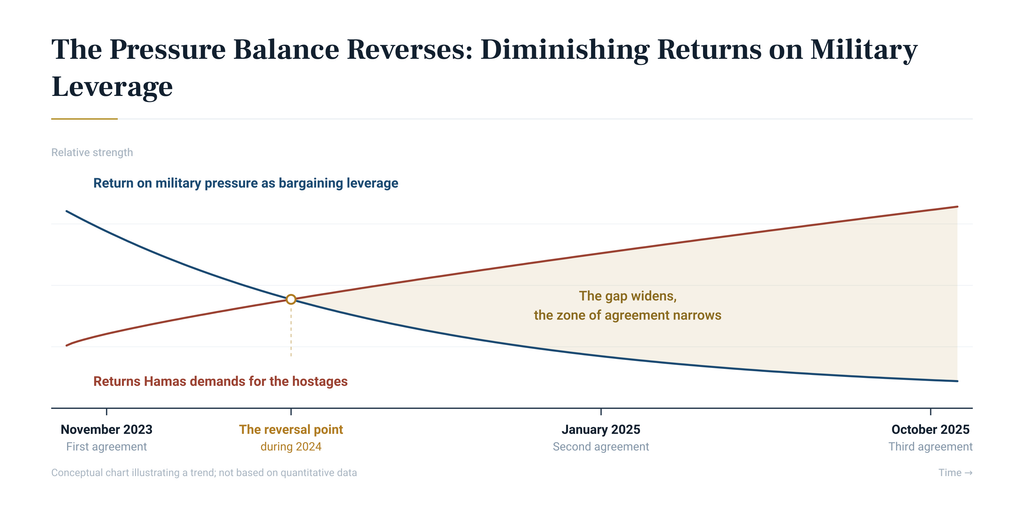
However, this concept suffered from two inherent strategic limitations. First, military power and negotiating power are not equivalent. The ability to inflict harm on the adversary does not guarantee the ability to compel it toward an agreement. Second, military pressure is a depleting lever. As the campaign lengthens, the adversary adapts, constraints on the application of force multiply, and its yield as a negotiation lever tends to decline.
At the beginning of the campaign, military pressure on Hamas proved highly effective for negotiation purposes. Israeli operations degraded the organization’s military capabilities, disrupted its operational readiness, threatened assets that had yet to be struck, and generated profound uncertainty regarding the continuation of the campaign. The military pressure was not confined to the ground manoeuvre alone, it also encompassed targeted killing of senior Hamas figures inside and outside Gaza Strip, rescue operations for living hostages, and operations to locate and retrieve fallen captives, all intended to undermine the organization’s confidence in its ability to retain hostages over time.
Less than four weeks after the launch of the ground manoeuvre on the night of October 27, 2023, implementation began on the first hostage release agreement, under which 105 hostages were freed during a seven-day pause. 80 Israelis in exchange for 240 Palestinian female and minor prisoners, at a ratio of three to one. An additional Israeli holding Russian citizenship was released separately as a gesture to Russia, and 24 Thai and Filipino nationals were freed under separate arrangements.
The timing of the deal, less than two months into the crisis, also stands in stark contrast to previous captive episodes with Hamas where, lacking sustained and significant military pressure, recovery efforts dragged on for years.
Nonetheless, Hamas’s readiness to consummate the first hostage agreement in November 2023 cannot be attributed solely to the “negotiating under fire” doctrine. Hamas possessed an independent interest in realizing this agreement. Releasing women and children mitigated the severe reputational and international liability associated with their detention. Concurrently, it allowed Hamas to retain male and female soldiers and additional hostages, whose continued captivity it could attempt to portray as more legitimate negotiating chips to achieve its broader strategic objectives in the war.
However, Hamas’s specific demands during the negotiations clearly revealed the impact of military pressure on its desire for an agreement. Following the IDF’s consolidation of control over Gaza City, the organization sought to halt the ground manoeuvre’s advance southward, to delay it or potentially freeze the entire campaign. Consequently, its core demands focused on the duration of the ceasefire, a daily pause in Israeli aerial surveillance collection, and an increase in humanitarian aid entering Gaza Strip. Conversely, Hamas demonstrated flexibility on the very issue that had anchored prior hostage exchanges: the quantity and identity of released prisoners.
This disparity underscores the value of military pressure at that juncture as a negotiating lever. For Hamas, halting the fighting, even temporarily, represented an asset of significant intrinsic value.
As the war dragged on, Hamas altered its operational patterns, decentralized its formations, and developed survival mechanisms that progressively mitigated the impact of military pressure upon it. In contrast, constraints accumulated on Israel, limiting its capacity to persist with unyielding pressure. The depletion of munitions and forces, the worsening humanitarian conditions in the Strip, the deepening public rift surrounding the hostage issue, the deterioration in the hostages’ physical condition, and the erosion of international legitimacy. In this context, it should be noted parenthetically that the hostage crisis in Gaza starkly exemplifies an expanding phenomenon in the international system that may be termed the “Protected Violator Paradox”,a player that systematically violates the norms of the international order while simultaneously exploiting its adversaries’ commitment to those very rules to restrict their operational freedom against it.
Thus, the better Hamas learned to absorb the costs of continuing the war, the higher the costs became for Israel to sustain it.
The temporal gap between the first hostage agreement in November 2023 and the subsequent agreement in January 2025, following more than a year of additional combat, reflects the growing difficulty of converting sustained military pressure into parallel progress at the negotiating table. Even when the application of force continued to yield significant military achievements, its return as a lever for the return of the hostages did not increase proportionally.
The failure lay not in utilizing military force as a lever to return the hostages, but in the failure of the negotiation strategy to adapt adequately to the declining value of this lever. Military pressure was a necessary condition for generating negotiating leverage against Hamas, but it was not a sufficient condition for securing an agreement.
The strategic lesson is that the application of force and negotiation must be integrated into a single strategic endeavour. The application of force must alter the adversary’s cost-benefit calculus and generate an opportunity for an agreement, while negotiations must convert that opportunity into an accord.
Hence, the strategic question is not merely how much pressure to exert, but when and how to convert it into an agreement. Military might that is not translated into negotiating power in a timely fashion may continue to yield battlefield gains, but its value as a lever at the negotiating table will steadily degrade.
Chart 1:
3. Partial Agreements:
Tactical Advantage, Strategic Disadvantage
One of Israel’s central strategic decisions was to focus negotiations on partial agreements, aiming to return as many hostages as possible during the war without conditioning their retrieval on reaching a single comprehensive accord.
This decision possessed clear humanitarian and practical logic. Each partial agreement accelerated the return of the hostages included within it, shortening their captivity, suffering and risk. In a reality where the hostages’ condition was steadily deteriorating and time worked against them, this was a heavyweight consideration.
As a rule, in crisis negotiations, a comprehensive deal is preferable. Partial agreements enable the earlier return of hostages even when gaps preclude a full settlement, however, they risk prolonging the crisis, inflating the cost of the final deal, and diminishing the captors’ incentive to reach an overall agreement. Their advantage is also their vulnerability: they make it possible to reach agreement where feasible, while deferring decisions on the very issues that delay and obstruct a complete resolution.
Israel was thus able to attempt to decouple the return of the hostages from decisions regarding the end of the war, circumscribing concessions primarily to elements related to campaign management, temporary pauses, shifts in troop deployments, humanitarian aid, and the release of security prisoners. In doing so, discussion of the strategic demands that Hamas sought to place at the center of bargaining, an end to the war, IDF withdrawal and shaping the postwar reality, could be deferred.
Yet herein lay the structural difficulty of this strategy. Israel sought to secure the release of hostages via partial concessions, whereas Hamas sought to leverage the hostage asset to extract strategic concessions.
As long as military pressure was at its peak and a temporary pause in fighting represented an asset of significant value to Hamas, this gap could be bridged. This model thereby contributed to achieving the first agreement in November 2023 and returning a substantial number of hostages.
Over time, however, three cumulative erosion mechanisms operated against this model.
The first, erosion in the value of the partial concessions Israel was willing to offer. As the war prolonged and Hamas adapted to military pressure, the relative value of a temporary pause in fighting and other combat management concessions declined. The gap between the negotiating chips Israel was willing to offer and the concessions Hamas demanded widened. Consequently, the subsequent agreement for the return of hostages matured only in January 2025, more than a year after the initial agreement.
The second, depletion of Israel’s inventory of negotiating assets. Measures that could have been converted into negotiating concessions, such as expanding humanitarian aid, troop withdrawals, opening border crossings, and civilian relief, were partially implemented during the war due to humanitarian and diplomatic constraints, without securing a reciprocal return of hostages. Thus, the Kerem Shalom crossing was reopened in December 2023 following the implementation of the first deal. Subsequently, the Erez crossing was reopened, and the use of the Port of Ashdod was expanded in the spring of 2024 following heavy American pressure and the deepening humanitarian needs, without being conditioned on hostage releases.
Hamas thus sought to convert the hostage asset not only into the release of prisoners, but also into gains concerning how the campaign was conducted and, ultimately, the conditions of its termination.
The third mechanism, the impact of each partial agreement on the negotiating balance of the next accord. Every deal altered the number of remaining hostages, their composition, and their relative value in the eyes of the parties. Simultaneously, the concessions granted within the partial agreement were no longer available to Israel as negotiating currency for the next round. Consequently, subsequent negotiations did not resume where the previous ones left off but began from a new and often more difficult negotiating balance. For example, in the January 2025 agreement, Israel conceded to a gradual withdrawal from the Netzarim Corridor and permitted the return of the population to northern Gaza as part of the concession package for that deal[15].
Hence the paradox of partial agreements emerged. Every deal delivered an immediate, invaluable human achievement, but concurrently altered the conditions under which the next agreement had to be secured.
The failure did not lie in the willingness to conclude partial agreements. When the opportunity exists to bring hostages home sooner, such an agreement holds immense value.
The failure lay in elevating the partial agreement from a component of a negotiation strategy into the negotiation strategy itself. So long as a temporary pause in fighting was a high-value concession for Hamas, the strategy proved effective. Once its value degraded and Hamas’s demands shifted to strategic concessions, it became imperative to reassess the strategy and the approach to retrieving the remaining hostages.
The strategic lesson is that a partial deal is not a strategy. Every partial agreement must be evaluated across two simultaneous time horizons: the immediate achievement for the hostages being released, and its impact on the capacity to return those left behind.
4. The Negotiating Team:
The Strength of the People, the Weakness of the Structure
In his seminal book The Best and the Brightest [16], David Halberstam describes a strategic paradox. An extraordinary group of brilliant, experienced, and widely respected government officials and corporate leaders steered the United States into a bloody quagmire in the Vietnam War. His critique is directed not at the caliber of the individuals, but at the institutional system within which they functioned. Individual brilliance, Halberstam demonstrates, does not guarantee systemic system excellence.
Secretary of Defense Robert McNamara epitomizes in the book a conceptual failure centred on the attempt to reduce a complex strategic reality into a quantifiable, controllable system. Quantitative metrics, such as enemy casualty counts or the number of bombing sorties, provided the campaign management leadership in Vietnam with a precise picture of what could be measured, but not necessarily of what was vital to understand: the adversary’s will, determination, absorptive capacity, and the overarching strategic logic driving its conduct.
The analogy to the Israeli negotiations lies in this very strategic paradox. How did a negotiating team composed of the senior most leaders of the defense establishment, among the most powerful figures in the country, fail to translate the excellence of its personnel and the institutional weight of its agencies into a commensurately effective negotiating system?
A comprehensive answer to this question will become possible only when the negotiation process is declassified to a degree permitting independent, multidisciplinary research. Nonetheless, based on existing public knowledge, a narrower yet fundamental question can already be examined: To what extent were the structure, composition and operating methods of the negotiating team aligned with the mission entrusted to it?
The “tip of the spear” of the team comprised the Director of the Mossad, David Barnea, the Director of the Shin Bet (ISA), Ronen Bar, and the Head of the IDF Hostage Intelligence Directorate, Maj. Gen. (Res.) Nitzan Alon. This senior and formidable composition possessed distinct advantages.
First, a unique concentration of capabilities. The Director of the Mossad provided working channels and access to the United States, Qatar, and Egypt. The Director of the Shin Bet contributed deep intelligence on Hamas, its leadership, and its operational patterns, alongside institutional conduits to Egypt. Maj. Gen. (Res.) Alon brought the up-to-date intelligence picture regarding the hostages and their captors, as well as a direct connection to the IDF’s operational campaign. Few compositions in Israel could assemble within a single room a comparable convergence of intelligence, access, and operational capability.
Second, extraordinary seniority and access. The team leaders were exposed to the most sensitive and current intelligence and maintained direct, unmediated access to national decision-makers, the Prime Minister, the defense minister, and the Chief of the General Staff. This forged a direct link among four critical dimensions of crisis management including policy, intelligence, operations and negotiations.
Third, complete control for the decision-making tier. Entrusting the leadership of negotiations to the heads of the Mossad and the Shin Bet, directly subordinate to him, afforded the Prime Minister direct control over the mandate and core decisions. Incorporating a senior IDF representative created a structural bridge to the military campaign, providing the Defense Minister and the Chief of Staff with a direct conduit to coordinate between combat operations and negotiation efforts.
Fourth, public and political value. Placing the mission in the hands of intelligence agency directors and a senior general conferred public authority and legitimacy upon the negotiation effort, signalling the supreme importance attributed by the state to the recovery of the hostages. At the same time, it broadened the foundation of responsibility for the process. Negotiations and their outcomes were identified not solely with the political leadership, but also with the senior security chiefs who conducted them in practice.
Yet these very advantages sharpen the core question: Was the team that represented extraordinary intelligence and operational power, unhindered access to decision-makers, and singular professional status also the most suitable team to conduct this complex, prolonged and unprecedented negotiation?
Examining the negotiating team from this perspective reveals six structural weaknesses.
The first, multiplicity of roles and institutional hats. Each member of the team bore expansive institutional responsibilities and pressing duties beyond the hostage recovery mission. The Director of the Shin Bet was responsible for the ongoing nationwide functioning of his agency, the decapitation campaign against Hamas leadership in Gaza, and providing operational intelligence to support ground manoeuvres. The Director of the Mossad was tasked with preparing and executing major components in the regional campaign against Iran and Hezbollah, alongside managing a wide array of intelligence and strategic interests across regional and international arenas. The IDF representative operated as part of a military establishment simultaneously conducting multi-front warfare.
It is natural and understandable that these additional missions and organizational responsibilities formed part of their ongoing calculus, however, the structural consequence is undeniable. Not a single member of the team’s leadership possessed a single, exclusive objective function dedicated entirely to maximizing negotiations for the hostages’ return.
The second, the gap in specialized crisis negotiation expertise. Seniority, command prestige, and excellence in intelligence or military operations are no substitute for professional expertise in crisis negotiation. The team members were not specialists in this discipline, and most lacked significant prior experience in managing hostage crisis negotiations[17]. Nor was this specialized expertise granted commensurate weight within the support apparatus surrounding them.
This phenomenon was not born on October 7. In previous Israeli hostage episodes as well, the selection of team leaders was generally determined by considerations other than specialized crisis negotiation expertise. The October 7 crisis thus inherited an existing pattern, but subjected it to a test unprecedented in its magnitude and complexity.
Hence the paradox. This was perhaps the most powerful team that could be assembled from Israel’s defense establishment, but not the most professionally tailored team that could be constructed for the negotiation mission itself.
This gap is illuminated by a simple analogy. All senior members of the team had previously served in elite special operations units and were trained in counterterrorism. Yet no one would have appointed them, solely by virtue of that background, to command an assault force in the tactical hostage rescue operations conducted during the war. Such a mission demands specialized expertise and contemporary tactical training.
Yet in the negotiations to retrieve those very same hostages, a different logic was applied. Seniority and general security experience were deemed largely sufficient to conduct complex crisis bargaining. This is not a critique of the individuals, but of the institutional doctrine. The system recognized that forcible hostage rescue requires specialized expertise, but failed to accord similar weight to the distinct expertise required to recover those hostages through negotiation.
The third, a multiplicity of organizations, not a task force. Each agency represented on the negotiating team brought its own organizational culture, institutional worldview, intelligence sources, professional vernacular, and organizational interests. While this is a source of substantial professional richness, it is also a wellspring of fragmentation and institutional friction. Seating three separate security agencies around a single table does not automatically generate a unified mission doctrine or a cohesive strategy.
An effective task force requires more than inter-agency coordination. It demands a unified objective, a single operational strategy, clear delineation of roles and authorities, and a single leader bearing ultimate accountability for the outcome. Lacking these, each agency brings to the table its capabilities and assets, but also its distinct institutional perspective, organizational constraints and priorities.
Such a structure also harbors the risk of groupthink, which paradoxically negates the core benefit of inter-agency diversity. Prolonged collaboration among the same closed circle of senior officials under conditions of extreme crisis can diminish mutual challenge, reinforce shared baseline assumptions, and sideline creative alternatives that fall outside the group’s consensus. This risk was particularly acute given that several leaders of the effort also carried the heavy burden of institutional accountability for the systemic failures preceding October 7.
Thus, another paradox emerged. The multiplicity of agencies around the table broadened the scope of information and capabilities, but failed to ensure a commensurate diversity of strategic concepts, working assumptions, and policy alternatives. The failure lay not in the multiplicity of organizations, but in the absence of a mechanism that synthesized them into a single, cohesive task force governed by a common objective, a unified strategy, a single director, and comprehensive accountability for the result.
The fourth, seniority lacking institutional counter-mechanisms. The more senior, experienced, and authoritative the figures seated around the table, the greater the structural necessity for an independent mechanism tasked with systematically challenging them, a Red Team or Devil’s Advocate designed to interrogate baseline assumptions, present competing interpretations, evaluate alternatives that did not originate within the core group, and persistently question whether the existing strategy is truly advancing the desired outcome.
In the absence of such a mechanism, the personal authority and towering stature of senior team members can cast an uncritical halo over their working assumptions and proposals, impeding rigorous internal scrutiny.
Here, the Best and the Brightest paradox re-emerges. The question is not whether the chosen individuals were sufficiently capable. Their personal caliber, vast experience, and dedication are beyond doubt. The question is whether their individual excellence and the structure within which they operated translated into systemic excellence in negotiation. Precisely because a team is composed of exceptionally senior, experienced and authoritative leaders, it requires an institutionalized mechanism to challenge its concepts, preventing confidence in the quality of its personnel from devolving into overconfidence in the validity of its assumptions.
The strategic lesson is that selecting the finest individuals from each agency is no substitute for building the team best tailored to the specific mission. A crisis negotiation team is not an “inter-agency executive forum”, but a specialized professional organism comprising a director with unambiguous authority, skilled negotiators, dedicated intelligence, subject-matter experts, an independent mechanism to challenge underlying assumptions, and agency representatives who channel their organizations’ respective capabilities and operational power into the effort.
The fifth, a strong team, a weak outward signal. The architecture of a negotiating team is not merely an internal organizational matter, it is also a strategic signal read and deciphered by the adversary and external mediators. The simultaneous presence of two intelligence directors alongside a senior general within the Israeli delegation, contrasted with the more centralized structures typical of the mediating delegations, risked being interpreted not only as a display of authority and seniority, but also as an indicator of fragmented authority, internal division, and acute dependence on decisions made outside the room.
Such a perception can directly shape the adversary’s conduct and negotiating posture. In protracted, low-trust negotiations punctuated by frequent pauses, every position taken is not merely an offer for the current round, but an anchor for the next. An adversary assessing that the opposing delegation is divided, its mandate tightly constrained, and its ability to deliver on commitments uncertain, is incentivized to minimize compromise and maximize positions. If the round collapses, the last posture presented risks becoming the baseline from which future negotiating resumes.
The lesson is that a negotiating team’s structure must be evaluated not only by the internal assets it convenes, but also by the power and resolve it projects outward. An effective team must project an unequivocal message of internal cohesion, decisive authority, a robust mandate, and the clear capacity to make commitments and implement agreements.
The sixth, intelligence as a foundation, not as a boundary. The core of the negotiating team was drawn from the senior echelons of the Israeli intelligence community. The purpose of intelligence is fundamentally to understand reality, what Hamas wants, what its condition is, what its constraints are, and how it is likely to act. The purpose of crisis negotiation is to alter reality, to shape interests, alternatives, and incentives in order to bring the opposing party tomorrow to agree to terms it refuses to accept today.
Herein lies the risk of intelligence dominance within a negotiation team. The analytical question “What is Hamas willing to accept?” which should serve as the starting point of negotiation, risks becoming the boundary of its possibilities. Rather than interrogating how Hamas’s posture can be shifted, negotiating tends to be confined within the parameters that intelligence assesses Hamas is currently prepared to accept.
This tension between the two disciplines surfaced prominently during discussions surrounding the first release agreement in November 2023. During negotiations, Hamas insisted on releasing only a subset of the women and children in its custody, rather than all of them as demanded by Israel. Situational assessments diverged regarding its motives. One assessment posited that Sinwar struggled to locate certain hostages and therefore refrained from committing to their release, another argued that Hamas’s stance was driven strictly by negotiating considerations.
The intelligence debate itself was legitimate. The structural complication lay in the fact that the same individuals on the team were required to wear two incompatible hats. As heads of the intelligence community, they were tasked with assessing why Hamas was presenting a given posture. As leaders of the negotiation, they were tasked with formulating moves to change it.
This tension intensified between the seventh and eighth release phases of that agreement. Hamas claimed that several female hostages slated for release were not in its possession and proposed altering the agreed-upon framework by releasing elderly male hostages instead. Once again, Israeli assessments were divided over whether this reflected a genuine barrier regarding those female hostages, or a negotiating manoeuvre designed to reduce the price Hamas had to pay for continuing the pause after having already extracted much of its value.
Decision-makers confronted a severe dilemma: insist upon the original terms of the agreement even at the cost of terminating it, or accept the proposed deviation in order to continue recovering hostages?
One approach argued that accepting Hamas’s claim regarding female hostages who Israel assessed with high probability were indeed in its custody would critically jeopardize the prospects of retrieving them later. The opposing approach contended that halting the deal would shutter an active window of opportunity, the reopening of which could take extensive time and demand far steeper concessions.
The intersection of political, military, intelligence, and negotiating considerations led Israel to reject the modification of the agreement’s terms. The implementation of the deal collapsed, and combat operations resumed. The subsequent hostage release agreement was achieved only more than a year later.
Intelligence must assess the adversary’s posture and the variables that shape it. Negotiation must determine how those variables can be influenced and transformed. Intelligence assessments must serve as the foundation of negotiation strategy, never its ceiling. When both functions are conflated within the same individuals lacking adequate methodological separation, the risk mounts that the intelligence appraisal of what the adversary is willing to concede today will inadvertently become the outer limit of what negotiations attempt to extract from it tomorrow.
5. Negotiation Mandate: Responsibility Without Authority
“Like Eating Soup with a Knife” [18]
In a democratic regime, the political echelon establishes the purpose, objectives, red lines, and scope of concessions in crisis, and adjudicates core issues. The role of the negotiating team is to conduct negotiating within the defined space, test boundaries, trade concessions, activate levers, formulate alternatives, and exploit opportunities in real time.
For this, a genuine negotiating mandate is required. not a list of positions the team is merely authorized to convey, but a defined zone within which it is empowered to manoeuvre.
In Israel, Amendment No. 9 to the Government Law, 2014, establishes a formal mechanism granting the Government of Israel authority to decide on the release of prisoners for political or security considerations, such as securing the release of hostages, diplomatic gestures, or within diplomatic agreements.
In practice, given the tight coupling between the negotiations and the military campaign and owing to the political structure of the emergency government, negotiating moves were repeatedly debated within the War Cabinet. This diverged from prior hostage episodes, where governmental involvement focused predominantly on decisions on matters of principle and formal approval of the agreement.
Concurrently, unprecedented media exposure of the negotiation process laid bare Israel’s internal disputes and the negotiating team’s reliance on repeated re-authorizations to both Hamas and the mediators. This compromised the team’s stature, flexibility, and capacity to capitalize on real-time opportunities. As it became apparent that substantive determinations were not made by those present in the negotiating room, an increasing share of actual negotiating shifted from the negotiation table to the political echelon behind it.
Thus, a paradox emerged. Instead of concentrating its efforts on shaping the zone of agreement with Hamas, the team was repeatedly forced to ascertain the zone of agreement with the political leadership in Israel. Without sufficient manoeuvring room, negotiations risk devolving from a problem-solving process into a mere transmission of static positions.
The disparity between the team’s operational responsibility for the outcome and its authority to shape the path toward it is especially acute in crisis negotiations, where windows of opportunity are fleeting. A shift in adversary posture, targeted military pressure, or a mediator initiative can briefly open an avenue for agreement. A team required to seek renewed approval for every significant modification may find that by the time authority is granted, the window of opportunity has already closed.
The failure was not that the political echelon retained ultimate strategic decision-making, that remains its legal authority and constitutional duty. The failure lay in the lack of a clearly delineated operational space between political decision-making authority and professional negotiating authority.
Within this space, the negotiating team needed to receive or secure an unambiguous mandate to manoeuvre and conduct negotiating in real time.
The strategic lesson is that responsibility without authority does not constitute an adequate mandate for effective negotiation. The political echelon must establish the acceptable destination and the red lines that cannot be crossed. The negotiating team should demand and must be granted the authority to navigate the path between them.
6. Negotiation Management: Those Who Do Not Lead, Are Led.
“The good news is that there is light at the end of the tunnel, the bad news is that there is no tunnel” [19]
An additional failure was the absence of an orderly, proactive, and continuous Israeli negotiation method. Throughout significant portions of the process, Israel acted reactively. Mediators initiated frameworks, convened summits, shuttled proposals between parties, and largely dictated the pace and agenda of the process. Israel reviewed proposals, responded to them, and waited, often for protracted intervals, for Hamas’s reply. Thus, rather than configuring the negotiation process as an instrument to influence Hamas, Israel operated largely within a process designed and managed by others.
There is no inherent fault in mediator initiative. In indirect negotiations, their role is vital, and at times no process would exist without them. The problem arises when mediation supplants the leadership of the negotiation. A state does not have to control every move in bargaining, but it requires an orderly method of action of its own. To initiate rather than merely react, manage time, synchronize levers, reward progress, exact a price for foot-dragging, manage multiple mediation tracks in parallel, and link what occurs at the negotiating table to the other components of national power.
Here, a stark divergence emerged between the two arenas. In the military domain, Israel denied Hamas stability, certainty, and freedom of action. In the negotiation domain, it struggled to generate parallel conditions to compel Hamas toward an agreement. The power exerted on the battlefield was insufficiently translated into a coherent system of influential levers within the negotiating process. For example:
A. Hamas leadership in Qatar | While Hamas leadership in Gaza faced continuous military and personal threats, the external leadership operated from a relatively secure environment in Qatar and played a central role in the mediation process. As long as their status, freedom of action, and advantages deriving from their presence in Qatar were not effectively tied to progress in negotiations, a gap persisted between their utility from participating in the process and the price to Israel of its delay[20].
B. The cost of time | Time is not merely a constraint in negotiations. It is a foundational lever that must be actively managed. An effective negotiation doctrine seeks to make progress advantageous and stalling costly. In practice, negotiating rounds, proposals, and summits took place repeatedly even after prior rounds failed to bear fruit. In the absence of a consistent mechanism linking progress to rewards and foot-dragging to tangible costs, Hamas lacked sufficient reason to prefer an agreement today over waiting for tomorrow.
Negotiations for the return of hostages are akin to threading a needle on the deck of a boat navigating turbulent waters. The task demands absolute precision, while the surrounding reality continuously shifts and sways. Precisely because of this, an orderly methodology is essential, not to eliminate uncertainty, but to enable purposeful action within it.
The unique nature of the October 7 crisis necessitated adaptation, creativity, and improvisation. It did not obviate the need for methodology. In its absence, the initiative shifted time and again to whoever offered the next outline, scheduled the next summit, and set the next timeline.
The Israeli failure was not the failure to hold a prefabricated solution to an unprecedented crisis, but that negotiations were not conducted according to an orderly methodology that enabled Israel to lead them.
Hence the lesson. In crisis negotiations, those who do not manage the process may find themselves managed by it. Initiative does not require control over every variable, but the ability to continuously shape the core elements of the negotiation process to increase both the attractiveness of an agreement for the other side and the penalty for failing to achieve one.
Preparing for the Next Hostage Crisis
The core lesson of the Gaza hostage crisis is not that in the next crisis Israel will require more intelligence, more military power, more mediators, or more senior officials. Rather, it will require a permanent national mechanism, prepared in advance, capable of organizing and translating its aggregate components of power into effective negotiating leverage.
By way of illustration, and with all necessary distinctions, this is how Israel prepared over the years for the missile threat. Confronting that threat, Israel developed a multi-layered concept integrating intelligence and cyber capabilities, offensive strike assets, multiple tiers of active defense, and civil defense. This concept was translated into long-term force design that encompassed research and development, budgeting, government resolutions, manufacturing, procurement, training and operationalization. When Israel was called upon during the years 2024-2026 to confront a direct threat from Iran, it did not begin assembling the response with the launch of the first missile, it successfully activated a national system that had been built, drilled, and refined over years.
The threat of abduction terrorism must be addressed in the same manner. A hostage crisis is not an event for which preparations can begin after it has already occurred, but as noted, an enduring national security threat that necessitates dedicated force build-up during peacetime.
The next abduction crisis will not be identical to the crisis of October 7. Its form, scale, the identity of the captors, the number of hostages, or the strategic circumstances in which it unfolds cannot be known in advance. Preparedness, therefore, cannot consist of prefabricating solutions for the previous crisis, but rather of constructing an enduring national capacity to confront a crisis whose contours and circumstances are inherently uncertain.
The apparatus to manage it can and must be prepared in advance: a national concept and doctrine, a clear architecture of command, responsibility and authority, professional capacity for crisis negotiation, dedicated intelligence tailored to this type of crisis, decision-making mechanisms, mediation frameworks and international channels, operational, legal, economic, and strategic-influence tools, and systematic exercises testing their execution as a unified system.
At the centre of this concept lies the requirement for a clear distinction between the political echelon that decides and the professional echelon. Currently, supreme national responsibility for hostage affairs rests with the Prime Minister, with no single state agency tasked with comprehensive professional responsibility for national force design and capability building to retrieve hostages from enemy hands.
As a result, the capabilities required for the mission are fragmented across diverse agencies, without a single professional entity bearing overarching accountability for building them, integrating them, exercising them, and preparing the system for the next crisis.
Under the proposed model, the organizational principle is centralized responsibility and decentralized capabilities. Political responsibility remains with the Government. Professional responsibility for capability development and crisis management will be consolidated within a single permanent, specialized entity, while execution capabilities and operational expertise will continue to reside within the respective agencies. The objective is not to centralize all state capabilities within a single body, but to unify under a single authority their activation as one integrated system for a single purpose.
The Government will continue to establish national purpose, priorities, red lines, and the scope of concessions the state is willing to consider. Operating directly beneath the political echelon, a permanent and dedicated professional apparatus will function, bearing responsibility during peacetime for capability design and during emergencies for the professional management of the crisis. It will translate government policy into a single operational strategy and synchronize all state efforts, negotiations, intelligence, operations, diplomacy, economics, strategic influence, media, families, legal affairs[21], and humanitarian dimensions[22].
Within this apparatus, crisis negotiation will exist as an autonomous professional discipline, rather than as a secondary byproduct of intelligence, operational, or diplomatic expertise. Just as executing a tactical hostage-rescue breach are specialized professions not acquired merely through general security experience, so too is the negotiation for the return of hostages a profession that must be constructed, taught, trained, and practiced.
During a crisis, this professional body will receive from the Government a genuine mandate and well-defined operational boundaries, within which it will possess the authority to conduct professional negotiating and capitalize on windows of opportunity in real time.
The lesson of the Gaza hostage crisis is that national power does not automatically translate into negotiating power. Just as Israel builds in peacetime the systems that will defend it against the next missile, so it must construct during peacetime the system capable of confronting the next abduction.
Conclusion: The Duty to Be Prepared
The October 7 hostage crisis was unprecedented in its scope, but its lessons are not confined to this single event. It touches upon a broader question: How does a state translate its aggregate national power into concrete capability to achieve a specific objective. In this case, the recovery of its people held captive by an enemy.
Abduction by a terrorist organization is fundamentally an asymmetric act. By controlling a limited number of individuals, an organization vastly inferior in overall balance of forces can confront a powerful state with an agonizing strategic dilemma, influence its national agenda, exert pressure on its society and leadership, and extract concessions far exceeding its military weight.
Consequently, confronting abduction terrorism cannot be measured solely by the magnitude of power the state can exert. The true test is its capacity to organize its aggregate power and translate it into influence over adversary behaviour and tangible results at the negotiating table.
This is one of the overarching lessons of the Gaza hostage crisis and of the broader history of hostage affairs between Israel and its enemies. Intelligence, military force, diplomacy, economics, strategic influence, mediation, and negotiation are not isolated, parallel efforts. Their value derives from how they are integrated into a single strategic endeavour. A military achievement not converted in time into negotiating leverage risks losing its value, intelligence not leveraged to influence adversary behaviour remains merely passive knowledge, a mediator that does not serve the strategy risks devolving from a lever into a constraining framework, and a negotiating team, however brilliant and senior, cannot fulfil its potential without methodology, a mandate, and operational maneuvering space.
From this arises a vital national imperative. Abduction terrorism will not vanish from the threat landscape, nor is it a rare anomaly for which preparations can be improvised after it occurs. In Israel, abduction terrorism is an enduring national security threat requiring ongoing force design in peacetime. Just as the state builds advance capabilities in intelligence, defense, and combat to confront other concrete threats, it must build during peacetime a national capacity for hostage crisis management and the negotiations inherent to it. The purpose of this force design is not to prefabricate the exact solution for the next crisis, but to establish in advance the institutional capability to reach that solution in real time.
The next abduction crisis cannot be prevented with certainty, nor can its exact form be known in advance. The adversary may be different, the circumstances distinct, the constraints novel, and the surprises unforeseen. A robust system is not one that claims to know in advance what to do in every scenario, but one capable of learning rapidly, challenging its own working assumptions, pivoting strategy as reality shifts, and maintaining the initiative even under conditions of extreme uncertainty.
The return of hostages is not merely an operational objective. It is a profound expression of the state’s covenant of responsibility toward its citizens and those deployed on its behalf. This responsibility dictates doing everything possible to rescue them and bring them home, but equally, learning everything possible from the price paid and the experience gained. The next abduction crisis cannot be predicted. Preparedness for it can and must be built. This is our duty to those who were rescued and returned, to those who did not return alive, and to those who may one day depend upon the State of Israel to bring them home.
“And there is hope for your future, declares the Lord, and your children shall return to their own border” | Jeremiah 31:17.
This article is dedicated, with profound respect, to the hostages who returned home and to those who were brought home for burial, to their courageous families and friends, to the men and women of the Israel Defense Forces (IDF), the Israel Security Agency (Shin Bet), the Border Police, and the covert operatives who served with extraordinary dedication and courage, risking their lives in operations to locate the hostages and bring them home, and to the countless people in Israel and around the world who never ceased their efforts, devoting their talents, abilities, strength, and hearts to the national mission of bringing the hostages home.
This extraordinary collective effort, sustained by determination, devotion, and a profound sense of mutual responsibility until the very last hostage was brought home, will never be forgotten.
[1] Israel’s Prime Minister’s speech to the Knesset on 24.01.24:
https://main.knesset.gov.il/en/news/pressreleases/pages/press24124x.aspx
[2] Evidence of this conceptual shift is found in the “Jericho Wall” plan formulated by Hamas, which outlined a blueprint for a large-scale attack within Israeli territory, including breaching the border, infiltrating communities, and seizing military objectives. The main points of the plan reached Israel more than a year before October 7.
https://www.nytimes.com/2023/11/30/world/middleeast/israel-hamas-attack-intelligence.html
[3] Daniel Sobelman │ The Strategic Origins of Hamas’s October 7 Attack, Studies in Conflict & Terrorism, published online January 12, 2026
https://cris.huji.ac.il/en/publications/the-strategic-origins-of-hamass-october-7-attack
[4] For example, Hamas deliberately concealed and obscured the fate of the hostages, including the distinction between the living and the fallen, and between civilians and soldiers.
[5] Minister Smotrich threatens to resign from the government if a hostage deal is approved, August 2025.
https://www.mako.co.il/news-politics/2025_q3/Article-cf6744deeb8c891027.htm
[6] For example, Marwan Issa, Deputy Head of the Military Wing (March 2024), Mohammed Deif, Head of the Military Wing (July 2024), Yahya Sinwar, Leader of Hamas (October 2024), and his brother Mohammed Sinwar (May 2025).
[7] Among the unique tasks of the special intelligence headquarters were in depth, individualized research on the fate, condition, and location of each hostage, close intelligence coordination with maneuvering forces to reduce the risk to hostages in combat areas, the production of dedicated intelligence for rescue operations, and the deployment of influence efforts aimed at hostage captors to prevent harm to the hostages and safeguard their well-being.
[8] The Israeli Voice Index of the Israel Democracy Institute from July 2024: 56% of the public supported a deal to return all hostages even at the cost of ending the war, compared to 29.5% who preferred a partial deal in exchange for a temporary pause.
https://en.idi.org.il/articles/55018.
[9] In October 2025, President Trump noted that “The people of Israel want this to happen,” and subsequently his administration adopted the principle of a comprehensive deal.
https://www.axios.com/2025/08/02/witkoff-hostage-families-trump-deal-gaza-war.
[10] Statement of the 27 European Union leaders, October 15, 2023.
[11] Examples of this trend reversal are the provisional measures issued by the International Court of Justice (ICJ) against Israel from January 2024 onward, and the arrest warrants issued by the International Criminal Court (ICC) in November 2024 against Prime Minister Netanyahu and Defense Minister Gallant.
[12] On October 16, 2023, the War Cabinet defined one of the war aims as “a maximum effort to resolve the hostage issue”. Beginning in November 2023, Netanyahu began publicly expressing the goal of “returning all of our hostages” as an objective alongside the dismantling of Hamas, and in August 2025, the government anchored “the return of all hostages, both living and fallen,” as one of the five principles for ending the war.
https://www.kan.org.il/content/kan-news/defense/569728
https://www.instagram.com/p/C0Pb8qEMizf
https://www.gov.il/he/pages/spoke-statement140825
[13] The Joint Statement by the State of Qatar and the Arab Republic of Egypt on Their Mediation Efforts in the Gaza Strip, issued on May 7, 2025, also reflects these tensions.
https://mofa.gov.qa/en/latest-articles/statements/joint-statement-between-the-state-of-qatar-and-the-arab-republic-of-egypt-on-their-mediation-efforts-in-the-gaza-strip.
[14] Particularly notable was the decisive role of the United States, which invested an extensive diplomatic effort throughout the crisis to return the hostages. President Trump placed this objective at the center of his policy and subsequently led a diplomatic initiative that ended the war and brought about the release of the remaining hostages.
[15] Under this agreement, 25 living hostages and eight fallen were returned to Israel in exchange for the release of hundreds of prisoners and more than a thousand Palestinian detainees. The second phase, which was intended to return the remaining living hostages and bring about a permanent ceasefire, was not implemented, and Israel halted aid to the Strip and resumed fighting.
[16] David Halberstam, The Best and the Brightest │New York: Random House, 1972.
[17] According to published reports, in 2022–2023 the Shin Bet conducted a covert mediation channel with Hamas for a deal to return the two civilians and the bodies of the two IDF soldiers held in Gaza. However, this negotiation should not be viewed as fully relevant experience, as it may itself have been part of Hamas’s deception and misdirection apparatus ahead of the October 7 attack.
[18] Like Eating Soup with a Knife: The American Experience in Vietnam 1959–1973 | Tal Tovy, 2006, Ma’arachot Publishing.
[19] A quote attributed to the late Shimon Pere, former Prime Minister and President of Israel, in the context of the Middle East peace process.
[20] With the exception of the targeted killing of Haniyeh in Iran in July 2024, Israel refrained throughout most of the war from targeting Hamas’s leadership in Qatar. This situation changed in September 2025, with the strike on Hamas’s top leadership in Doha.
[21] For example, a new international legal framework is required to counter abduction terrorism, including a distinction between prisoners of war and civilian hostages, holding accountable states and entities that maintain ties with a hostage-taking organization, conditioning international arrangements with a hostage-taking organization on the return of the hostages, and developing international enforcement mechanisms and sanctions.
[22] An example of the humanitarian arena’s impact on a hostage-taking organization is the creation of a mechanism to deliver aid to Gaza without going through Hamas. This mechanism reduced the organization’s ability to extract resources from the aid and leverage its distribution to consolidate its control over the population, thereby creating a lever of pressure on it.

