

Operation “Epic Fury:” SITREP (3 MAR 2026)
Bottom Line Up Front:
- U.S.–Israel Campaign Intensifies: Operations “Roaring Lion” and “Epic Fury” continued on 3 MARCH with sustained strikes across Iran targeting missile infrastructure, military production facilities, and key regime assets. The IDF reported neutralizing approximately 300 Iranian missile launchers and deploying around 4,000 munitions since the start of the campaign. The strikes appear to pursue four main objectives: degrading Iran’s offensive missile capabilities, disrupting logistical and industrial support networks, weakening domestic security forces, and targeting core governmental and intelligence institutions, including facilities linked to the Presidential Office and the Supreme National Security Council.
- Conflict Internationalizes: Additional international actors are becoming involved. France and the United Kingdom announced they will deploy military assets to the Middle East region, Qatar reportedly conducted retaliatory strikes against Iran, and the United States signaled it may accompany oil tankers through the Strait of Hormuz.
- Iran Expands Regional Retaliation: Iran continued launchin waves of missile and drone attacks against Israel, the Gulf states, and regional actors hosting U.S. forces. Targets included energy infrastructure, U.S. diplomatic and military facilities, and strategic economic assets.
- Escalation on the Lebanon Front: Hezbollah increased rocket and drone attacks against central and northern Israel. In response, Israel expanded airstrikes across Lebanon, targeting Hezbollah infrastructure, and began limited ground operations in southern Lebanon to strengthen the forward defense of northern Israeli communities.
- Risk of Wider Regional and Maritime Escalation: Iran’s proxies in Iraq expanded their operations against the U.S. interests in Iraq and the Kurdish infrastructure. The Houthis threatened to expand the conflict by targeting maritime routes such as the Bab al-Mandab Strait, raising concerns about potential disruption to global energy flows and international shipping.
Overview of Operations “Roaring Lion” and “Epic Fury”
On 3 MARCH 2026, Israel and the United States continued Operations “Roaring Lion” and “Epic Fury,” a large-scale, jointly coordinated military campaign against Iran. According to the IDF, since the beginning of the campaign, Israeli forces have neutralized approximately 300 Iranian missile launchers and dropped around 4,000 munitions across Iran in continuous waves of strikes targeting the regime’s missile and military infrastructure.
Analysis of targets on 3 MARCH against Iran includes four main goals: First, decreasing the offensive military capability. For example, on 3 MARCH, the IDF reported striking the secret “Min-Zadaei” complex, which was reportedly used by the Iranian regime to develop capabilities required for nuclear weapons. In addition, the IDF announced the killing in Tehran of Daoud Ali-Zadeh, the deputy commander of the IRGC Quds Force Lebanon Corps. Additional strikes across Tehran targeted weapons production infrastructure, particularly ballistic missile manufacturing facilities, which Israel views as a strategic threat.
Second, targeting the logistical capability by attacking ammunition depots and storage infrastructure in a way that weakens Iran’s ability to sustain a prolonged war. For example, on 3 MARCH, reports indicate that a major Saipa automobile manufacturing facility in Iran was struck. Such facilities may have been targeted due to their potential dual-use role in military logistics or industrial support for the defense sector. Strikes also reportedly targeted industrial zones, including areas around Hakimiyeh Industrial Zone in Tehran and Payam Airport in Karaj, suggesting an effort to disrupt transportation and military supply networks.
Third, target domestic security forces by continuing to attack police stations and district commands, to undermine the regime’s capabilities to suppress future protests or attempts to overthrow the regime. Such examples include the police station in Sanandaj, Iran.
Fourth, targeting the governmental and intelligence core. For example, on 3 MARCH, the IDF struck government and security buildings within the leadership compound in central Tehran, including the Presidential Office, the Supreme National Security Council building, and other key decision-making and military training facilities. Additional reports indicated that buildings associated with the Assembly of Experts in Qom were also struck, although the facilities had reportedly been evacuated beforehand.[1]
Operation Against Iran Expands Internationally
The conflict involving Iran has increasingly drawn in international actors as regional tensions escalate. French President Emmanuel Macron stated that France has defense agreements with Qatar, Kuwait, and the United Arab Emirates, noting that the latter two had come under attack and emphasizing that France must support its partners.[2] The United Kingdom also announced additional deployments to the region, with Prime Minister Keir Starmer confirming that Britain had sent helicopters equipped with counter-drone capabilities and the air-defense destroyer HMS Dragon to Cyprus, alongside other naval assets to the Middle East.[3] France similarly ordered the deployment of its aircraft carrier Charles de Gaulle to the region.[4]
Qatar reportedly carried out strikes against Iran in response to Iranian missile attacks.[5]
U.S. President Donald Trump stated that the U.S. Navy would escort oil tankers through the Strait of Hormuz if necessary, underscoring the growing international involvement in the conflict.[6]
IDF Operation against Hezbollah in Lebanon Expands
In response to Hezbollah’s escalation, the IDF launched a series of operations across Lebanon targeting key Hezbollah infrastructure. Israeli strikes focused on Hezbollah facilities in southern Lebanon as well as strategic locations in Beirut, including the Dahiya district. According to the IDF spokesperson, Israeli forces struck more than 160 targets, including weapons depots, launch sites, command centers, and communications infrastructure linked to Hezbollah’s intelligence headquarters. Additional strikes targeted propaganda and communications facilities, including satellite communication components and the Al-Manar broadcasting building in Dahiya. The IDF also reported the killing in Beirut of a senior figure responsible for Hezbollah’s military buildup on behalf of the IRGC Quds Force.
At the same time, the IDF ground forces began operating in southern Lebanon, holding several positions as part of a forward defense strategy to protect northern Israeli communities.
The escalation between Hezbollah and Israel has also triggered broader regional developments, including reports that Syrian forces began concentrating troops along the Syria–Lebanon border.[7]
Overview of Iran’s operations and developments
Political Developments in Iran
In Iran, President Masoud Pezeshkian, Judiciary Chief Mohsen Eje’i, and Ayatollah Alireza Arafi held a meeting as part of the interim leadership council of Iran. The meeting focused on preparations for the upcoming elections to the Assembly of Experts, the body responsible for selecting Iran’s Supreme Leader. Following the meeting, President Pezeshkian stated that all preparations for the elections had been completed and that there were no obstacles to the process.
Iran Encourages Regional Solidarity following Khamenei’s Killing
Following the killing of Ayatollah Ali Khamenei, Iranian-affiliated clerics and figures have encouraged expressions of solidarity with Iran across the region. Senior cleric Grand Ayatollah Nouri Hamedani called on the Iranian armed forces and Hezbollah supporters to maintain their presence and commitment to the resistance, urging continued mobilization and religious devotion to confront Iran’s enemies and continue the path of the “martyred leader.”[9]
Bahrain-based cleric Ayatollah Isa Qassim condemned the killing, blamed the United States and Israel, and called on Muslims to strengthen resistance and jihad in response. These calls have contributed to pro-Iran demonstrations and unrest in Bahrain, where supporters of the Iranian regime clashed with security forces. Similar pro-Iran and anti-U.S./Israel demonstrations were reported elsewhere in the region, including large gatherings in Istanbul and Yemen, reflecting Tehran’s efforts to mobilize regional support and frame the killing as a rallying point for the wider “Axis of Resistance.”
Trends in Tactics and Internal Security Developments
According to U.S. Central Command (CENTCOM), Iranian forces have been using mobile missile launchers to fire missiles. U.S. forces are actively tracking these launchers and intercepting the threats. Meanwhile, Iranian opposition channels reported that in the past 24 hours, the Islamic Revolutionary Guard Corps (IRGC) and Basij forces have begun using schools, mosques, and hospitals as operational bases, suggesting efforts to disperse military infrastructure within civilian areas.
An IRGC spokesperson stated that Iran’s responses would be stronger and more destructive than those seen in the final stages of the previous 12-day war, noting that the missiles currently being used are more advanced and upgraded compared to those employed in Operation “True Promise 3.”
Iranian Military Operations
Iran has continued launching waves of missile and drone attacks against Israel as well as several Gulf and regional states, including the United Arab Emirates, Bahrain, Kuwait, Qatar, Saudi Arabia, Jordan, Oman, Cyprus, and Kurdish targets in Iraq.
According to multiple reports, Iran’s target selection against the aforementioned states falls into three primary categories:
Strategic-Economic Infrastructure. Iran has expanded its attacks to strategic economic assets, particularly energy infrastructure across the Gulf region, on 3 MARCH. Recent reports indicate that Iranian drones struck oil storage facilities in Oman, including a hit on an oil tank and a suicide drone attack at the Ras Isah port. In contrast, another Iranian drone reportedly struck an oil storage facility in Fujairah in the United Arab Emirates. These attacks appear aimed at disrupting regional energy infrastructure and increasing the economic pressure on Gulf states involved in the conflict.
Attacks on U.S. and Allied Military and Diplomatic Assets. Iran claimed responsibility for several missile and drone attacks targeting U.S. military installations and allied assets across the region. For example, on 3 MARCH, reported attacks included a drone strike on the U.S. Embassy in Dubai, drone attacks targeting the U.S. Embassy in Saudi Arabia, and an attack against U.S. forces stationed at Sheikh Isa Air Base in Bahrain. In Iraq, Iranian strikes reportedly targeted a Kurdish military base and political offices, including the Azadi Camp, which belongs to the Iranian Kurdish Democratic Party in the city of Koya in the Kurdistan Region of Iraq. These attacks indicate an expansion of Iran’s campaign against U.S. diplomatic presence, military forces, and allied groups across the region.
In the past several days, Iran also targeted civilian targets with prominent hotels as a key target. Together, these moves indicate a strategy that combines military, economic, and diplomatic pressure to increase the cost of the conflict and enhance regional and international influence.
Hezbollah
On 3 MARCH, Hezbollah intensified its attacks against Israel, launching rockets toward Central and northern Israel while also carrying out attacks using drones, missiles, and anti-tank RPG fire against Israeli targets. The organization has also renewed its use of suicide drones, attempting to wear down Israel’s air defense systems through repeated launches and sustained pressure on defensive capabilities.
Hezbollah continued escalating its attacks while framing each strike as a response to Israeli actions. In its statements, the organization justified its operations as retaliation for what it described as “Israeli aggression” against Lebanese cities, including Beirut’s southern suburbs. For example, Hezbollah claimed that on 3 MARCH 2026, it targeted the Haifa naval base with a series of precision missiles at 20:00 (UTC+02), and later launched a rocket barrage toward central Israel, targeting the Al-Jalalah plateau north of the Kfar Yavne settlement at 23:20 (UTC+02). Overall, Hezbollah reported carrying out 13 separate attacks on 3 MARCH, reflecting a continued escalation in the intensity and scope of its operations.
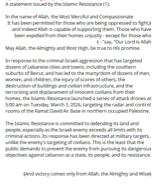
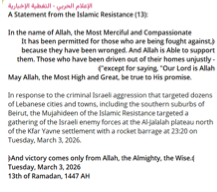
Official statement by Hezbollah on response against Israel (Military Media of Hezbollah Telegram Channel, 03 MAR 2026)
Pro-Iranian Iraqi Shiite Militias
On 3 MARCH, pro-Iranian Shiite militias in Iraq escalated their operations against U.S. and coalition assets in the Erbil area of the Kurdistan region. A militia identifying itself as “Kurdistan Revolutionary Hezbollah” claimed responsibility for a suicide-drone strike on a hotel in Erbil, reportedly hosting U.S. personnel, as well as an attack targeting the U.S. military installation at Erbil International Airport. Additional strikes were reported against the U.S. consulate compound and the international coalition base located near the airport.
The Islamic Resistance in Iraq stated that the attacks were conducted as part of a coordinated retaliation campaign following the killing of Ayatollah Ali Khamenei. According to militia statements, the operations involved coordinated rocket and drone strikes, including the use of Murad-5 drones (reportedly based on the Shahed-101 platform). They claimed that more than 80 missiles and drones were launched toward Erbil. They also reported conducting 27 separate operations since the early hours of 3 MARCH, targeting U.S. military facilities and coalition positions in Iraq and across the wider region.
Pro-Iranian militias in Iraq portray these attacks as retaliation for U.S. military actions against Iran and the killing of Ayatollah Ali Khamenei, framing them as acts of revenge in solidarity with Tehran. Though tactically autonomous, Iraqi pro-Iranian militias remain ideologically aligned with Iran and connected through regional support networks, including Hezbollah and the Houthis, known as the “Axis of Resistance.”
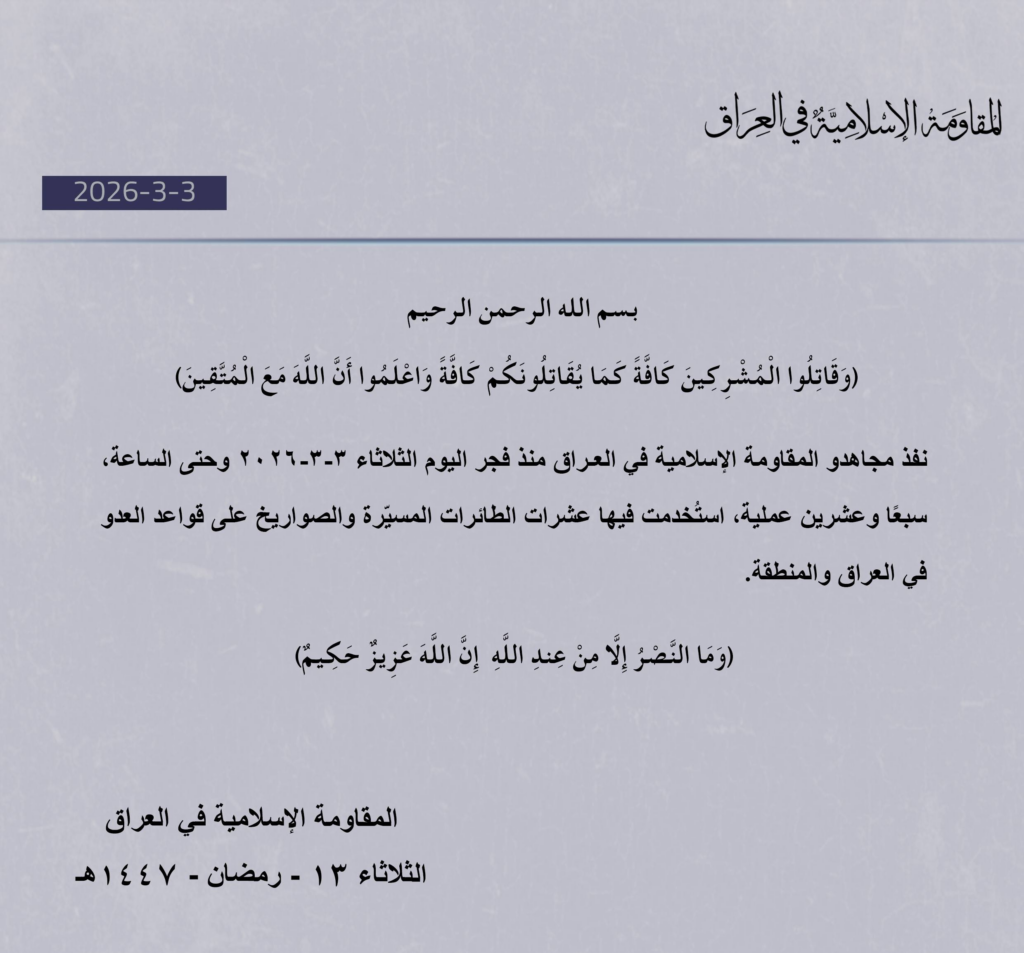
Official statement by Pro-Iranian Shia Militias from Iraq – The Islamic Resistance in Iraq: “The Mujahideen of the Islamic Resistance in Iraq have carried out 27 operations since dawn on Tuesday, March 3, 2026”. (official Telegram Channel, 03 MAR 2026)
Ansar Allah (Houthis)
The Yemeni Ansar Allah (Houthi) movement issued statements condemning Israel’s military escalation in Lebanon and expressing support for Hezbollah and the Lebanese resistance. In an official statement, the group’s political bureau accused Israel of violating the ceasefire agreement and attempting to impose a new reality that undermines Lebanese sovereignty. The statement reaffirmed what it described as Lebanon’s legitimate right—both as a state and through resistance movements—to respond to Israeli military actions. Ansar Allah also called on Arab and Islamic countries to adopt stronger positions in support of Lebanon and against what it described as a broader Israeli-American plan in the region.
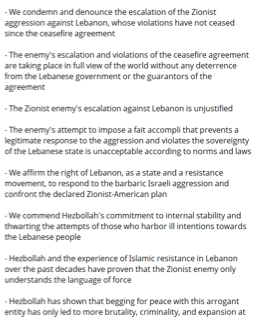
Official statement by the political bureau of Ansar Allah (official Telegram Channel, 03 MAR 2026)
At the same time, senior Ansar Allah officials warned that the group could expand the conflict if regional actors intervene against Iran. A senior Houthi figure stated that if Saudi Arabia participates in military strikes against Iran, the Houthis would seek to close the Bab al-Mandab Strait and enter into a full-scale confrontation with Saudi Arabia, highlighting the potential for further escalation in the Red Sea and along critical global maritime routes.
The Cyber Domain
The cyber domain has also remained a prominent arena, with pro-Iranian hacker proxy groups and official Iranian cyber units continuing to conduct attacks against Israel, the United States, and other states that are involved in the conflict.
The pro-Iranian hacker group Islamic Cyber Resistance in Iraq – Team 313 claimed responsibility for a series of cyberattacks targeting government and infrastructure websites in the region. Reported targets included the Dubai Government Media Office, Kuwait’s Jazeera Airways, the Kuwaiti Ministry of Electricity and Water, and the Kuwait Ports Authority, with the attacks allegedly causing temporary shutdowns of these sites. The group also claimed to have targeted Israeli defense-related systems, including servers associated with Rafael’s Iron Dome and VigilAir drone detection systems, presenting the cyber operations as coordinated with missile and rocket attacks against Israel.
The pro-Iranian hacker groups Islamic Cyber Resistance and C.E. Army claimed responsibility for a coordinated cyber campaign targeting several Israeli websites. According to their statements, the attacks targeted the website of the right-wing Otzma Yehudit party, the College of Management Academic Studies, the Noam movement, Elbit Systems, the Pitchon Lev charity organization, Powercom Ltd., and websites linked to Israeli medical and mental health services. The groups presented these cyberattacks as part of a broader digital front within what they described as the “battle of the promise of the Hereafter.”
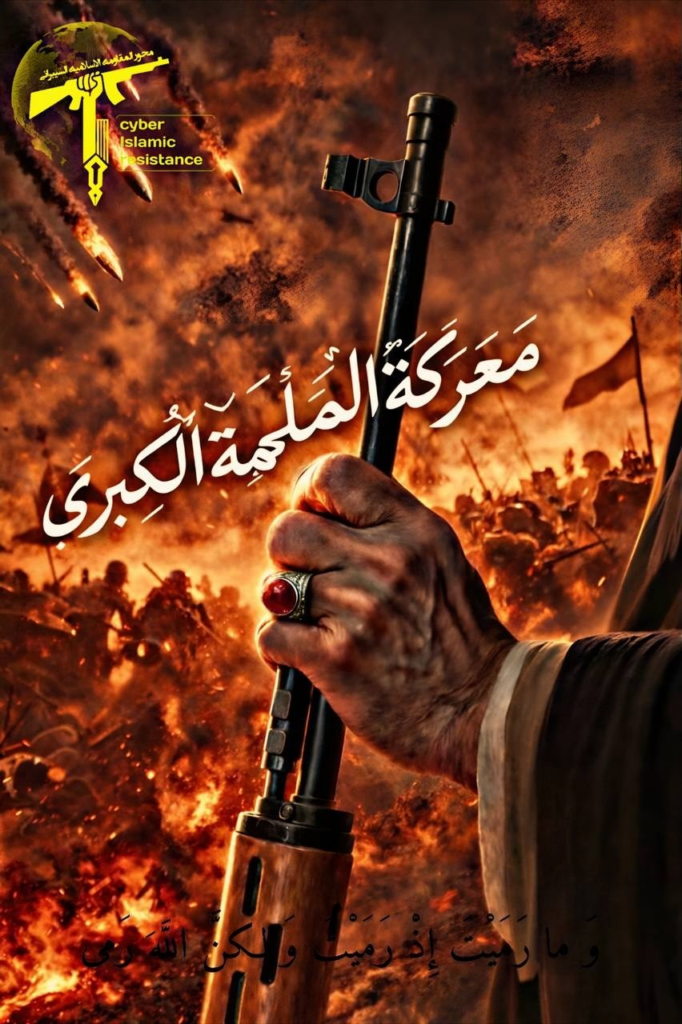
Islamic Cyber Resistance Campaign Image (official Telegram Channel, 03 MAR 2026)
The pro-Iranian cyber group FADTEAM, affiliated with the Islamic Resistance in Iraq, claimed responsibility for breaching the WeLearn Israeli academic platform, stating that it had gained access to registered users’ data. The group framed the cyberattack as retaliation for the death of Ayatollah Ali Khamenei, presenting the operation as part of the broader campaign carried out by Iran-aligned actors against Israeli targets.
The Pro-Iranian hacking group Handala claims to have hacked the Aramco facilities, and the Institute for National Security Studies in Israel claiming they were able to extract internal information.
Handala hacking group claim attack on Aramco (official Handala website, 03 MAR 2026)
The hacking group Cyber Support Front claimed responsibility for a cyberattack targeting Israeli communications infrastructure. According to the group, the operation infiltrated over 160 data centers across Israel, disrupting military and government networks and allegedly destroying sensitive data and documents. The group stated that the attack caused significant disruptions to Israel’s defense systems and indicated that additional details and documents from the operation would be released later.
Pro-Iranian hacker groups operate as proxy actors, extending Iran’s broader campaign into the cyber domain. Their activities mirror the attacks carried out by Iran and its regional proxies in the physical arena, targeting similar objectives across the region. The recent wave of cyber operations, particularly those directed at energy infrastructure and strategic economic assets, illustrates how cyber capabilities are being used to reinforce Iran’s wider regional pressure strategy.
[1] https://www.timesofisrael.com/israel-strikes-iranian-clerics-gathering-to-elect-new-supreme-leader/
[2] https://www.timesofisrael.com/liveblog_entry/france-sending-aircraft-carrier-to-mediterranean-says-macron/
[3] https://www.bbc.com/news/articles/c4g40yp2p13o
[4] https://www.france24.com/en/france/20260303-live-macron-addresses-french-nation-on-widening-war-in-the-middle-east
[5] https://www.jpost.com/middle-east/iran-news/article-888681
[6] https://www.timesofisrael.com/liveblog_entry/trump-says-us-navy-could-escort-tankers-through-strait-of-hormuz/
[7] https://www.thenationalnews.com/news/mena/2026/03/03/syria/
[8] https://www.iranintl.com/en/202603030390
[9] https://www.jpost.com/middle-east/iran-news/article-888528


