

Operation “Epic Fury:” SITREP (2 MAR 2026)
Bottom Line Up Front:
- U.S.–Israel Joint Campaign: On 2 MARCH, the U.S. and Israel continued coordinated military operations against Iran under Operations “Roaring Lion” and “Epic Fury,” targeting IRGC missile infrastructure, logistical networks, domestic security forces, and key intelligence institutions in an effort to degrade both Iran’s offensive capabilities and its internal regime control mechanisms.
- Iran Expands Regional Retaliation: Iran responded with waves of missile and drone attacks not only against Israel but also against multiple regional states hosting U.S. military assets, including the UAE, Bahrain, Kuwait, Qatar, Saudi Arabia, Jordan, Oman, and Cyprus, signaling a deliberate geographic expansion of the conflict.
- Targeting Strategy Focused on Economic and Strategic Pressure: Iranian attacks concentrated on three main categories of targets: strategic economic infrastructure, particularly energy facilities and maritime traffic in the Strait of Hormuz; U.S. and allied military and diplomatic assets across the Gulf; and civilian or symbolic urban locations intended to increase political and economic pressure on regional governments.
- Proxy Escalation Across the Region: The conflict entered a new phase as Iranian proxy actors intensified their involvement. Hezbollah formally joined the war on 2 MARCH and began launching rocket and drone attacks against Israel, while pro-Iranian Iraqi Shiite militias escalated UAV and rocket attacks on U.S. bases in Iraq and the wider region.
- Cyber Domain Emerges as a Parallel Battlefield: Pro-Iranian hacker groups and Iranian cyber units expanded cyber operations against Israel, Gulf states, and U.S. interests, targeting government platforms, energy companies, and critical infrastructure. These operations mirror developments in the physical battlefield, highlighting the integration of cyber warfare into the broader conflict.
Overview of Operations “Roaring Lion”
On 2 MARCH 2026, Israel and the United States continued Operations “Roaring Lion” and “Epic Fury,” a large-scale, jointly coordinated military campaign against Iran.
Analysis of targets of the U.S.-Israel attacks against Iran includes four main goals: First, decreasing the offensive military capability by attacking IRGC bases and missile sites. In this way, the launching of missiles towards Israel and the countries of the region will be significantly reduced. They have also focused on key assets of the regime such as the Iranian regime’s media and propaganda center. Second, targeting the logistical capability by attacking ammunition depots and storage infrastructure in a way that weakens Iran’s ability to sustain a prolonged war. Third, target domestic security forces by attacking police stations and district commands, which may undermine the regime’s capabilities to suppress future protests or attempts to overthrow the regime. Fourth, targeting the governmental and intelligence core, and particularly the Ministry of Intelligence, is a strategic move that strikes one of the main hubs of decision-making and national security. The overall pattern indicates an attempt to damage both the external offensive capability and the domestic control.
Overview of Iran’s operations
In response, Iran has continued launching waves of missile and drone attacks against Israel as well as several Gulf and regional states, including the United Arab Emirates, Bahrain, Kuwait, Qatar, Saudi Arabia, Jordan, Oman, and Cyprus. These operations signal a deliberate expansion in both geographic scope and target selection. This is also reflected in statements by Iran’s Foreign Minister, Abbas Araqchi, who has sought to justify attacks on neighboring states on the grounds that they host U.S. interests: “The Kuwaitis used to say that their bases were not being used against Iran. So, what were these three fighters doing that were targeted today on Kuwaiti soil? …We do not consider this a regional war, but rather a war between us and the United States, whose effects have extended across the region.”
According to reporting on 2 MARCH, Iran’s target selection against the aforementioned states falls into three primary categories:
- Strategic-economic infrastructure. Iran has expanded its attacks to strategic economic assets, particularly energy infrastructure. A reported drone strike on Saudi Aramco’s Ras Tanura refinery led to operational shutdowns. It was also widely reported that Iran has targeted oil tankers in and around the Strait of Hormuz; in parallel, senior officials of Iran’s Islamic Revolutionary Guard Corps (IRGC) have publicly declared the Strait of Hormuz “closed,” warning that any ship attempting to transit the vital oil chokepoint would be attacked. The attacks on economic targets are intended to raise the financial and political costs of the conflict, pressuring for an end to the war.
- Attacks on U.S. and allied Military and diplomatic assets: Iran has claimed to have carried out missile and drone attacks against U.S. military assets and their allies. Examples of attacks from March 2 include U.S. naval facilities in Bahrain, the Fifth Fleet area of operations, drone attacks against a UK base in Cyprus, and an attack on the U.S. embassy in Riyadh.[1] Simultaneous launches were also reported towards Kuwait, Qatar, Bahrain, and the United Arab Emirates, indicating an expansion of the attack circle to any country hosting a U.S. military presence in the region.[2]
- Attacks on Civilians and Symbolic Targets: Iranian attacks on 2 MARCH have affected civilian infrastructure and symbolic urban locales across Israel and the Gulf states, including explosions and damage in cities such as Dubai, Kuwait City, and Doha. For example, Iran claimed that it had launched a drone attack on a hotel in Bahrain that was hosting U.S. defense officials. Since Saturday, Iranian strikes have caused damage to tourism-related sites across several Gulf states, increasing economic and political pressure on these governments. By targeting locations associated with tourism and international travel, such as hotels, airports, and prominent urban landmarks, Iran appears to be aiming to undermine a key pillar of Gulf economies and raise the costs of their alignment with the United States and Israel.
Together, these moves indicate a strategy that combines military, economic, and diplomatic pressure to increase the cost of the conflict and enhance regional and international influence.
Iranian proxies enter the war: regional escalation and strategic implications
The third day of the war marked a significant escalation, with intensified attacks carried out by Iranian proxy groups, most notably Hezbollah and pro-Iranian Shiite militias from Iraq.
Hezbollah
Hezbollah’s initial rocket and drone attack on Israel on 1 MARCH, reportedly framed as retaliation for Ayatollah Ali Khamenei’s death, did not constitute a formal declaration of entry into the war. However, on 2 MARCH, the organization issued an official statement announcing its decision to join the conflict and has since conducted operations against Israel, primarily through rocket and drone attacks. The organization justified its actions by arguing that Israeli military operations in Lebanon over the past fifteen months had caused sustained casualties and widespread destruction, while diplomatic efforts had failed to secure a ceasefire. Meaning, Hezbollah framed its response as an act of legitimate self-defense and retaliation for ongoing IDF attacks in Lebanon, emphasizing that its strikes back are directed at Israeli military targets.
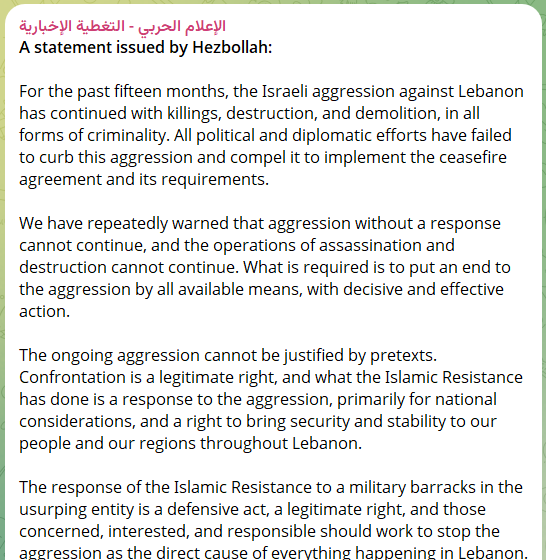
Official statement by Hezbollah on response against Israel (Military Media of Hezbollah: official Telegram Channel, 02 MAR 2026)
The escalation occurred against the backdrop of a fragile ceasefire framework between Israel and Lebanon. Since the agreement was reached, Hezbollah has continued to operate in southern Lebanon in violation of the ceasefire while simultaneously rebuilding and expanding its capabilities. Israel, in turn, has carried out targeted strikes aimed at enforcing the terms of the agreement. Although the Lebanese government formally committed to dismantling Hezbollah’s armed presence in southern Lebanon as part of the agreement, enforcement by the Lebanese Army has been partial and inconsistent, meaning that Hezbollah has not fully disarmed.
Domestically, Hezbollah entered this phase of escalation from a constrained political position. Following the election of President Joseph Aoun and the failure of Hezbollah’s preferred candidate to secure leadership, the organization’s influence within formal state institutions decreased. It has also faced growing criticism within Lebanon for contributing to instability and for allegedly subordinating Lebanese national interests to Iranian strategic priorities. When Hezbollah’s Secretary-General, Naim Qassem, declared the organization’s intention to intervene if the U.S. and Israel were to attack Iran, internal political pressure intensified.
Following the death of Ayatollah Ali Khamenei and the U.S.–Israeli military campaign in Iran, as well as Hezbollah’s renewed operations against Israel, Hezbollah has faced growing criticism within Lebanon. This criticism peaked on 2 MARCH in statements by Prime Minister Nawaf Salam, who declared that Lebanon would prohibit independent Hezbollah military activity and emphasized that decisions regarding war and peace must remain under state authority. President Joseph Aoun reinforced this position, stressing the need to consolidate weapons under the control of the Lebanese state. These developments reflect an effort by the Lebanese leadership to prevent the country from being drawn into a broader regional war and to reassert state authority over decisions of war and peace.
The Israel Defense Forces (IDF) launched an operation against Hezbollah in Lebanon, targeting Hezbollah facilities in southern Lebanon as well as other locations across the country, including Beirut’s Dahiya district. In an official statement, the IDF spokesperson claimed that Israeli forces struck more than 70 targets, including weapons depots, launch sites, and launchers of the terrorist organization Hezbollah.
Pro-Iranian Iraqi Shiite militias
Pro-Iranian militias in Iraq have escalated their offensive operations against U.S. interests in Iraq, claiming to have carried out at least 23 UAV and rocket attacks on U.S. bases and forces in Iraq (primarily in Erbil and Baghdad) and across the region. They have also begun targeting Kurdish forces in Northern Iraq, identifying them as allies of Israel and the U.S.
The militias portray these attacks as retaliation for U.S. military actions against Iran and the killing of Ayatollah Ali Khamenei, framing them as acts of revenge and solidarity with Tehran. Though tactically autonomous, Iraqi pro-Iranian militias remain ideologically aligned with Iran and connected through regional support networks, including Hezbollah and the Houthis, known as the “Axis of Resistance.”
The cyber domain
The cyber domain has also remained a prominent arena, with pro-Iranian hacker proxy groups and official Iranian cyber units continuing to conduct attacks against Israel, the United States, and other states that are involved in the conflict, such as the Gulf states, Jordan, and Saudi Arabia.
For example, on 2 MARCH, the Fatimyoon Electronic Team, a hacker group identifying with pro-Iranian militias in Iraq, claimed responsibility for cyberattacks targeting Qatar, Bahrain, and Kuwait. According to the group, the attacks targeted the official website of Qatar Radio and Qatari Gasco, an oil and energy company, while dozens of cyberattacks were reportedly launched against oil-related company websites in Qatar. In Bahrain, the Bahrain News Agency government website was reportedly taken offline. Similarly, another group identifying itself with the Islamic Resistance in Iraq, known as “313 Team” claimed responsibility for hacking the Dubai government website, stating that it had “completely disabled the site.” The group also claimed to have breached the main servers of the UAE government, asserting that the attack disrupted the official UAE government platform and its data portal. In its statement, the group warned that “the hand of revenge will reach the killers of Imam Khamenei.” Other reported targets included the Jordanian National Cyber Security Center.
Official statement by Hacking Team 313 (Team 313 Telegram Channel, 02 MAR 2026)
Other pro-Iranian hacker groups, such as the Cyber Islamic Resistance claimed to have hacked cameras of Israel’s health care service, Macabi, as part of what they call the campaign for “the Battle of the Great Epic within the War of the Promise of the Hereafter”.
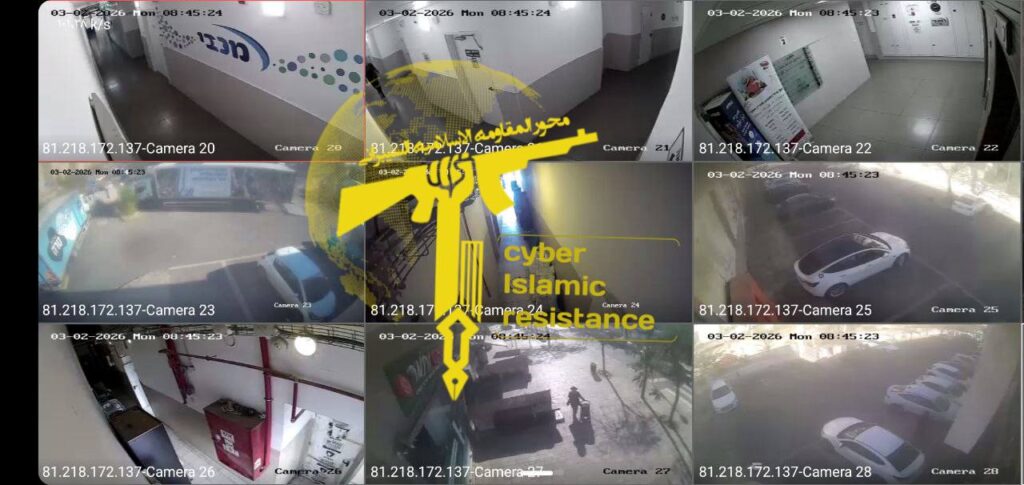
Official statement by Hacking Team Cyber Islamic Resistance (Cyber Islamic Resistance official X Channel, 02 MAR 2026)
Another pro-Iranian group, the Handala hacker group, also claimed to have joined the campaign targeting energy and economic infrastructure. The group stated that it conducted a cyberattack against the Sharjah National Oil Company, claiming to have disabled critical infrastructure systems and exfiltrated approximately one-third of a terabyte of sensitive data, including financial records, contracts, and internal documents. In its statement, the group warned that “no one is safe” and threatened further disruption to oil flows in the region.
At the same time, the Iranian Cybersecurity Command announced that it had targeted what it described as the “enemy’s access routes” through cyber and cognitive operations. Iranian authorities also issued public guidance warning of alleged cyber intrusion attempts by Israeli intelligence services, claiming that Mossad-linked cyber teams were distributing fake application updates in order to infiltrate networks and prepare for cyberattacks. Citizens were advised to delete unknown applications, limit the use of foreign messaging platforms, avoid suspicious links, and rely only on official sources for software updates.
Pro-Iranian hacker groups appear to be aligning their operations with the broader war effort, conducting cyberattacks that parallel developments in the physical battlefield. Targets identified in the kinetic domain are translated into objectives in cyberspace, demonstrating that the cyber arena has become an integral component of the conflict for both sides.
[1] https://apnews.com/article/iran-israel-us-03-03-2026-8755877b603e46ed3df8107689c1ee23
[2] https://timesofindia.indiatimes.com/world/middle-east/us-israel-iran-war-news-live-udates-conflict-attack-middle-east-state-dubai-qatar-airways-of-emergency-explosions-tehran-gulf-countries-netanyahu-trump-us-ali-khamenei/liveblog/128959227.cms?utm_source=chatgpt.com


